

Key information about vitamin D
Function: Vitamin D is essential for the absorption of calcium and phosphorus and for proper bone mineralization. It also plays a role in muscle function and other processes in the body.
Sources: Vitamin D can be obtained from food, supplements, and, most importantly, production in the skin after exposure to ultraviolet B (UVB) radiation.
Test: The test used to assess vitamin D levels is the blood measurement of 25-hydroxyvitamin D, also called calcidiol.
Levels: There is no single “ideal” vitamin D level that applies to everyone. In general, levels below 20 ng/mL warrant attention, but cutoff values vary according to the guideline and clinical context.
Symptoms: Mild deficiency usually causes no symptoms. When more severe or prolonged, it can cause muscle weakness, bone pain, and osteomalacia in adults; in children, it can cause rickets.
Screening: Current international guidelines advise that healthy people without risk factors do not need routine vitamin D testing.
Supplementation: Not everyone with a vitamin D level below 30 ng/mL necessarily needs to take a supplement. The indication depends on the level found, age, diet, sun exposure, associated medical conditions, and risk of complications.
Excess: High doses of supplements can cause toxicity, hypercalcemia, and kidney damage. More vitamin D does not necessarily mean greater benefits.
Other diseases: Low vitamin D levels are associated with several diseases, but this does not mean that taking supplements prevents cancer, heart attacks, dementia, high blood pressure, or other conditions in people who already have adequate levels.
Vitamin D: what we know today
Vitamin D, also known as calciferol, is a substance essential to health, mainly because of its role in controlling calcium and phosphorus levels and maintaining healthy bones.
In recent decades, vitamin D has received considerable attention in the media and the medical community. Several studies have found an association between low vitamin D levels and cardiovascular disease, diabetes, infections, cancer, autoimmune diseases, and many other conditions.
However, it is important to distinguish between two different situations: having low vitamin D levels associated with a particular disease does not necessarily mean that taking vitamin D will prevent or treat that disease. Correlation does not necessarily imply causation.
This distinction explains why many benefits initially attributed to vitamin D supplements were not confirmed when tested in large clinical trials.
In this article, we will explain how vitamin D is produced and activated, its main functions, which foods are sources of this vitamin, what low vitamin D means, and when supplementation may actually be necessary.
What are vitamins?
A vitamin is defined as an organic compound that is essential for normal metabolic function, required in small amounts, and that the body cannot synthesize or cannot synthesize in sufficient quantities.
There are 13 vitamins considered essential, obtained mainly through food. Vitamin D is an important exception because it can be produced in the skin when there is adequate exposure to ultraviolet B (UVB) radiation from sunlight.
Vitamins are indispensable to health, but their role is often overestimated. It is common to imagine that vitamin supplements can generally increase strength, combat fatigue, improve immunity, stimulate appetite, or prevent disease. In most people who do not have a vitamin deficiency, however, consuming extra doses does not provide these benefits.
Each vitamin performs specific functions in the body. Vitamin K, for example, participates in the activation of proteins required for blood clotting; vitamin B12 is important for red blood cell production and nervous system function; vitamin A plays a fundamental role in vision and in maintaining the tissues that line various parts of the body; and vitamin C participates in collagen synthesis and wound healing and acts as an antioxidant.
In addition, we need only small amounts of vitamins. More does not necessarily mean better. When certain vitamins are consumed in excessive doses, especially through supplements, they can accumulate in the body and cause toxic effects. This condition is called hypervitaminosis.
Why is vitamin D different from other vitamins?
The main difference between vitamin D and other vitamins is that the body can produce it in significant amounts. This production occurs in the skin when it is exposed to ultraviolet B (UVB) radiation from sunlight.
For this reason, vitamin D has some distinctive characteristics. Although traditionally classified as a vitamin, it also functions as a precursor in a hormonal system. Vitamin D produced in the skin or obtained from food undergoes transformations in the liver and kidneys until it becomes calcitriol, its most biologically active form, which exerts its effects through receptors found in various tissues.
Another important characteristic is that vitamin D is fat-soluble, meaning that it dissolves in fat and can be stored in the body. This allows the body to build reserves, but it also explains why excessive supplement use can cause vitamin D to accumulate and lead to toxicity.
What is vitamin D?
There are two main forms of vitamin D:
- Vitamin D3 (cholecalciferol): Found in some foods of animal origin, present in many supplements, and produced by the skin after exposure to UVB rays.
- Vitamin D2 (ergocalciferol): Found mainly in certain fungi and used in some supplements and fortified foods.
Vitamin D produced in the skin or absorbed from food must still undergo transformations before it can fully exert its effects in the body. The illustration below summarizes the vitamin D activation process, which is described next.
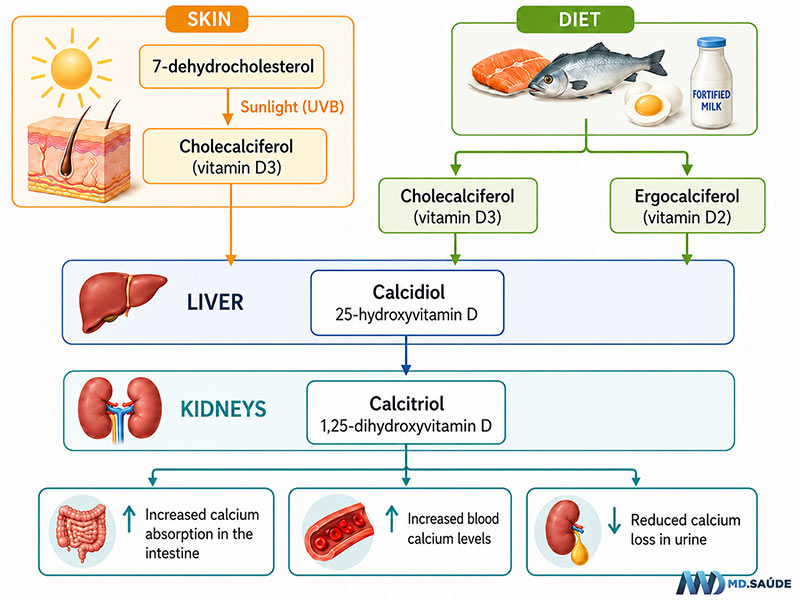
The skin contains a substance called 7-dehydrocholesterol, which is derived from cholesterol metabolism. When the skin receives UVB radiation, 7-dehydrocholesterol initiates a series of reactions that result in the formation of vitamin D3, also called cholecalciferol.
Vitamin D3 produced by the skin and vitamins D2 and D3 obtained from food or supplements are transported to the liver for the first stage of the activation process.
First stage: liver
In the liver, vitamin D obtained from food or produced in the skin undergoes its first transformation and is converted into 25-hydroxyvitamin D, also called calcidiol or 25(OH)D.
Calcidiol is the main form of vitamin D circulating in the blood and has a relatively long half-life. Its concentration reflects vitamin D obtained through skin production, food, and supplements used during the preceding weeks.
For this reason, measuring 25-hydroxyvitamin D is the main test used to assess vitamin D status in the body.
Second stage: kidneys
After transformation in the liver, some calcidiol is transported to the kidneys, where it can be converted into 1,25-dihydroxyvitamin D, also called calcitriol or 1,25(OH)₂D, the most biologically active form of vitamin D.
Calcitriol production is carefully regulated by the body according to calcium and phosphorus levels, parathyroid hormone (PTH), and other substances.
Vitamin D and sun exposure
Exposure to UVB radiation allows the skin to produce vitamin D3 and can account for an important portion of the vitamin D available in the body.
The amount produced, however, varies greatly among individuals.
The main factors that affect vitamin D production in the skin include:
- Season and latitude: During winter and in regions farther from the equator, the amount of available UVB radiation can decrease significantly.
- Time of day: The amount of UVB radiation reaching the Earth’s surface varies throughout the day.
- Skin pigmentation: Melanin absorbs some ultraviolet radiation. People with darker skin tend to need more exposure to produce the same amount of vitamin D as people with lighter skin.
- Age: The skin’s ability to produce vitamin D decreases with age.
- Amount of skin exposed: Clothing that covers much of the body reduces the surface area available for vitamin production.
- Time spent outdoors: People who are institutionalized, bedridden, or spend nearly all their time indoors are at greater risk of having low levels.
- Atmospheric conditions: Clouds, pollution, and other factors can modify the amount of UVB radiation reaching the skin.
Another important detail is that UVB radiation barely passes through ordinary glass. Therefore, exposure to sunlight through a window is not an effective way to produce vitamin D.
How much sun exposure is necessary?
It is not possible to establish a universal recommendation such as “10 or 15 minutes of sun per day.”
The amount needed depends on latitude, season, time of day, skin pigmentation, age, exposed body area, and the intensity of ultraviolet radiation.
The same duration of exposure can produce very different amounts of vitamin D in a light-skinned person living in a tropical region during summer and in a dark-skinned person living in northern Europe during winter.
In addition, there is an important concern: the same ultraviolet radiation that stimulates vitamin D production can also damage the DNA of skin cells and increase the risk of skin cancer.
Therefore, it is not advisable to get sunburned, deliberately prolong sun exposure, or stop using sun-protection measures merely to increase vitamin D levels.
Excessive exposure to ultraviolet radiation is associated with premature skin aging and the development of skin cancers, particularly basal cell carcinoma, squamous cell carcinoma, and melanoma.
When the ultraviolet index is high, protective measures should be taken, including suitable clothing, shade, and sunscreen.
Does sunscreen cause vitamin D deficiency?
Under experimental conditions, sunscreens reduce the amount of UVB radiation that reaches the skin and can therefore decrease vitamin D production.
In real life, however, people rarely apply enough sunscreen to completely block UVB radiation across all exposed skin. Consequently, there is insufficient evidence that routine sunscreen use is an important cause of vitamin D deficiency in the general population.
If a person is at high risk of deficiency and needs to avoid sun exposure, the safer alternative is to obtain vitamin D through food or, when indicated, supplements—not to deliberately increase exposure to ultraviolet radiation.
Does indoor tanning produce vitamin D?
Tanning beds should not be used as a means of obtaining vitamin D. These devices emit ultraviolet radiation, generally with a predominance of UVA and variable amounts of UVB. The UVB fraction can stimulate vitamin D production, but deliberate exposure to ultraviolet radiation increases the risk of skin damage and skin cancer.
Foods rich in vitamin D
Few foods naturally contain large amounts of vitamin D.
The best natural sources are fatty fish and fish liver oils. Smaller amounts can be found in egg yolks, liver, and certain types of mushrooms.
Dietary sources of vitamin D include:
- Cod liver oil: About 1,360 IU per tablespoon.
- Cooked trout: About 645 IU in a serving of approximately 3 ounces (85 g).
- Cooked salmon: About 570 IU in a serving of approximately 3 ounces (85 g).
- Mushrooms exposed to UV radiation: The content varies considerably; white mushrooms exposed to UV radiation may provide about 366 IU per half cup.
- Egg: About 44 IU per large egg, concentrated mainly in the yolk.
- Beef liver: About 42 IU in a serving of approximately 3 ounces (85 g).
- Canned tuna: About 40 IU in a serving of approximately 3 ounces (85 g), although the content varies according to the species and product.
These values can vary considerably depending on the fish species, the animal’s diet, the production method, and how the food is prepared.
Some processed foods are fortified with vitamin D, including certain types of milk, plant-based beverages, yogurt, margarine, and cereals.
Not all milk, cheese, or yogurt contains a significant amount of vitamin D. The addition of this vitamin to foods varies among countries, manufacturers, and products; therefore, the presence and amount of vitamin D should be checked on the label.
Fruit and most vegetables are not significant sources of vitamin D.
For healthy adults, a frequently used dietary reference is approximately 600 IU (15 µg) of vitamin D per day from ages 19 to 70 and 800 IU (20 µg) per day after age 70, assuming little sun exposure.
These figures represent dietary reference requirements, not doses intended to treat an already diagnosed vitamin D deficiency.
What does vitamin D do?
The best-established function of vitamin D is related to calcium and phosphorus metabolism.
Calcitriol increases the intestinal absorption of these minerals and helps maintain adequate blood calcium concentrations and proper bone mineralization.
Severe vitamin D deficiency can cause:
- Rickets in children: Growing bones do not mineralize properly, and bone deformities may occur.
- Osteomalacia in adults: Bone tissue is not adequately mineralized, making bones more fragile and potentially causing bone pain and muscle weakness.
Vitamin D also contributes to normal muscle function. Severe deficiency may be associated with muscle weakness, especially in muscles close to the trunk, such as those in the thighs and hips.
Vitamin D deficiency can also contribute to poorer bone health in people with osteoporosis, although osteoporosis and osteomalacia are different diseases.
Does vitamin D prevent other diseases?
Vitamin D receptors are found in various tissues, and low 25-hydroxyvitamin D levels have been associated in observational studies with numerous conditions, including:
- Cancer.
- Cardiovascular disease.
- High blood pressure.
- Diabetes mellitus.
- Alzheimer’s disease.
- Multiple sclerosis.
- Autoimmune diseases.
- Respiratory infections.
Older adults, people with obesity, sedentary individuals, people living in institutions, and those with chronic diseases may have lower vitamin D levels precisely because of their health status, diet, or reduced sun exposure.
Therefore, there are two different questions:
Does vitamin D play a role in the body’s normal function?
Yes.
Does taking vitamin D in doses above normal requirements prevent disease in people who already have adequate levels?
For most diseases studied, this benefit has not been consistently demonstrated.
Large clinical trials have not confirmed that indiscriminately giving high-dose vitamin D supplements to the healthy population is an effective strategy for preventing cancer, cardiovascular disease, dementia, or most other chronic diseases.
There are specific situations in which certain guidelines recommend supplementation even without prior testing, such as in children and adolescents, pregnant women, adults aged 75 or older, and some individuals with high-risk prediabetes. These recommendations do not mean that megadoses of vitamin D are beneficial for the entire population.
Does vitamin D improve immunity?
Vitamin D participates in regulating the immune system, and vitamin D receptors are found in several cells involved in the immune response.
This helps explain why observational studies frequently find an association between low vitamin D levels and a higher incidence or worse course of some infections.
Once again, however, association does not necessarily mean causation.
Older adults, frail individuals, people with obesity, and those with chronic diseases may simultaneously have a greater risk of infection and lower vitamin D levels.
The clinically relevant question is not only whether people who are ill have low vitamin D levels, but whether giving vitamin D to people without a deficiency actually reduces their risk of becoming ill.
Clinical trial results are mixed. Supplementation may provide some benefit in specific populations, but the evidence does not support the indiscriminate use of high-dose vitamin D to “boost immunity.”
How is vitamin D deficiency diagnosed?
The test used to assess vitamin D levels in the body is the measurement of 25-hydroxyvitamin D (calcidiol). It is the main form of vitamin D circulating in the blood and, because it remains in the body longer, is the principal marker of vitamin D status.
Calcitriol, or 1,25-dihydroxyvitamin D, should not routinely be measured for this purpose because its levels are tightly regulated by the body and may remain normal even when vitamin D deficiency is present.
What is considered a normal vitamin D level?
There is no single blood level that is universally accepted as the cutoff for vitamin D deficiency, insufficiency, or sufficiency. Reference ranges vary among countries, laboratories, and medical organizations.
In the United States, the National Institutes of Health, based on criteria from the National Academies of Sciences, Engineering, and Medicine, interprets serum 25-hydroxyvitamin D [25(OH)D] levels as follows:
- Below 12 ng/mL (30 nmol/L): Associated with vitamin D deficiency and an increased risk of rickets in children and osteomalacia in adults.
- Between 12 and 20 ng/mL (30–50 nmol/L): Generally considered inadequate for bone and overall health in healthy individuals.
- 20 ng/mL (50 nmol/L) or higher: Generally considered adequate for most healthy individuals.
- Above 50 ng/mL (125 nmol/L): May be associated with adverse effects, particularly at substantially higher concentrations.
In the United Kingdom, the Scientific Advisory Committee on Nutrition considers the risk of poor musculoskeletal health to increase when 25(OH)D levels fall below 10 ng/mL (25 nmol/L). The National Institute for Health and Care Excellence also notes that levels between 10 and 20 ng/mL (25–50 nmol/L) may be inadequate in some people, whereas levels above 20 ng/mL (50 nmol/L) are sufficient for most.
Some laboratories and clinical guidelines use different cutoffs, particularly when evaluating people with osteoporosis, malabsorption, chronic kidney disease, secondary hyperparathyroidism, or other conditions that affect vitamin D metabolism.
Does every vitamin D level below 30 ng/mL require treatment?
The 2024 Endocrine Society guideline emphasizes that clinical trials have not established a universal 25(OH)D level that all healthy people should reach to prevent disease. The guideline therefore recommends against routine vitamin D testing in healthy adults who do not have a specific medical indication for testing.
Consequently, it is not correct to assume that every healthy adult with a vitamin D level of 22, 25, or 28 ng/mL necessarily needs supplementation to raise the concentration above 30 ng/mL.
This does not mean that vitamin D supplements are never appropriate. General intake recommendations, seasonal supplementation policies, and the treatment of people with confirmed deficiency or specific medical conditions are separate issues.
The test result should always be interpreted together with the person’s age, symptoms, associated medical conditions, bone health, medications, and risk factors.
What are the symptoms of low vitamin D?
Mild or moderate deficiency usually causes no symptoms.
Therefore, nonspecific symptoms such as fatigue, malaise, hair loss, or mood changes should not automatically be attributed to vitamin D simply because the test result is below the laboratory’s reference range.
When deficiency is more severe or prolonged, muscle weakness, difficulty getting up from a chair or climbing stairs, and bone pain or tenderness may occur.
In severe and prolonged cases, deficiency can cause osteomalacia in adults and rickets in children. Muscle weakness may also contribute to a higher risk of falls, especially in older adults.
Severe deficiency can also cause abnormalities in blood calcium and phosphorus levels.
Who is at greater risk of deficiency?
The main risk groups include:
- People with very limited sun exposure.
- Older adults, especially those living in institutions or who rarely leave home.
- People with very dark skin who live in regions with low UVB radiation.
- Patients with diseases that cause intestinal fat malabsorption, such as celiac disease, Crohn’s disease, and certain pancreatic diseases.
- People who have undergone certain types of bariatric surgery.
- Patients with chronic kidney disease.
- People who use certain medications that interfere with vitamin D metabolism, such as some antiseizure medications (for example, phenytoin, carbamazepine, and phenobarbital), glucocorticoids used for prolonged periods, and certain antiretroviral medications or liver enzyme inducers, such as rifampin.
- People with a very low dietary intake of vitamin D combined with little sun exposure.
Obesity is associated with lower average concentrations of 25-hydroxyvitamin D, but obesity alone does not mean that a person needs a vitamin D test.
Should everyone have their vitamin D level checked?
No. Vitamin D testing has become common in routine blood work, but current major guidelines do not recommend indiscriminate screening of healthy, asymptomatic people.
The Endocrine Society recommends against routine measurement of 25-hydroxyvitamin D in healthy adults without another clinical indication. Obesity or more deeply pigmented skin alone also does not justify periodic testing.
In the United Kingdom, NICE likewise advises against routine vitamin D testing in asymptomatic people. Testing is generally recommended when deficiency is clinically suspected or when specific risk factors are present.
The test is most useful when vitamin D deficiency is clinically suspected or when knowing the result may change the diagnostic evaluation or treatment. Examples include osteomalacia or rickets, osteoporosis in certain contexts, hypocalcemia, secondary hyperparathyroidism, malabsorption syndromes, chronic kidney disease, and the use of medications that significantly interfere with vitamin D metabolism.
Therefore, belonging to a group with a greater likelihood of having low levels does not, by itself, mean that periodic testing is necessary. The decision depends on whether the result will have a practical effect on the patient’s management.
When is vitamin D supplementation necessary?
There are two main situations in which supplementation may be indicated: to treat an identified deficiency or preventively in groups expected to benefit even without prior vitamin D testing.
When there is documented deficiency and replacement is indicated, the dose and duration of treatment depend on the severity of the reduction, age, bone health, associated conditions, and other clinical factors.
In addition, some people may receive preventive supplementation without prior measurement of 25-hydroxyvitamin D. Recommendations vary according to age and the guideline used, but may include situations such as:
- Infants, children, and adolescents in certain age groups, mainly to ensure adequate intake and prevent rickets.
- Pregnant women, for whom some guidelines recommend supplementation during pregnancy without routine laboratory screening.
- Adults aged 75 or older, for whom the Endocrine Society suggests empiric vitamin D supplementation.
- Some people with high-risk prediabetes, in whom supplementation may be considered as an adjunct to lifestyle changes.
For healthy adults younger than 75, however, there is insufficient evidence to recommend vitamin D doses above usual dietary requirements solely to prevent disease.
It is also unnecessary to try to raise everyone’s 25-hydroxyvitamin D level above 30 ng/mL. A result slightly below this threshold, by itself, does not mean that the patient needs high doses of vitamin D.
When treatment is truly necessary, the dose should be determined according to the degree of deficiency, age, body weight, intestinal absorption capacity, associated conditions, and response to replacement.
Which forms of vitamin D are used for treatment?
Different forms of vitamin D are used for supplementation and treatment. The main ones are cholecalciferol (vitamin D3), ergocalciferol (vitamin D2), calcifediol (calcidiol), and calcitriol.
They correspond to different stages of vitamin D metabolism, are not equivalent, and should not be used interchangeably without medical guidance. The choice depends on the reason for treatment, the formulation available, and the patient’s clinical condition.
Cholecalciferol, or vitamin D3
Cholecalciferol (vitamin D3) is the form most commonly used to prevent and treat uncomplicated vitamin D deficiency. It is the same form naturally produced by the skin after exposure to UVB radiation.
After ingestion, cholecalciferol must still be converted in the liver into calcifediol (25-hydroxyvitamin D) and subsequently, mainly in the kidneys, into calcitriol (1,25-dihydroxyvitamin D), the most biologically active form.
Cholecalciferol is widely available as drops, oral solutions, tablets, softgels, and capsules. Lower-dose products are commonly sold without a prescription, while high-dose formulations used to treat deficiency may require a prescription in some countries.
The concentration varies greatly among products. Tablets and capsules may contain 400, 800, 1,000, 2,000, 5,000, 25,000, or 50,000 IU, depending on the formulation and country. Liquid products may state the dose per drop, per milliliter, or per measured serving.
Therefore, the number of drops, tablets, or capsules required to reach a particular dose depends entirely on the product being used. The most important information is the amount of vitamin D, expressed in international units (IU), contained in each drop, milliliter, tablet, or capsule.
These differences are clinically important. One liquid product may provide 400 IU per drop, whereas another may provide 1,000 IU per drop or express the dose per milliliter rather than per drop. Switching products while continuing to take the same number of drops can therefore result in a substantial change in the dose administered.
Ergocalciferol, or vitamin D2
Ergocalciferol (vitamin D2) can also be used to prevent and treat deficiency. Like cholecalciferol, it must be transformed by the liver and kidneys before it can fully exert its effects.
Vitamin D2 can increase 25-hydroxyvitamin D concentrations, but cholecalciferol generally produces a more efficient and sustained increase in blood levels. For this reason, when both forms are available, vitamin D3 is usually preferred.
In the United States, 50,000 IU ergocalciferol capsules are commonly available by prescription and may be used in deficiency-replacement regimens. In the United Kingdom and several other countries, cholecalciferol products are more commonly used. Availability and prescribing practices vary among countries.
Calcifediol, or calcidiol
Calcifediol, also called calcidiol or 25-hydroxyvitamin D3, is the form produced when cholecalciferol is transformed in the liver.
The concentration of 25-hydroxyvitamin D is precisely what is measured in the blood when a test is ordered to assess vitamin D levels.
When calcifediol is administered directly as a medication, the hepatic conversion stage is bypassed. Consequently, the blood concentration of 25-hydroxyvitamin D tends to increase more rapidly and predictably than with cholecalciferol.
Calcifediol may be used to treat deficiency in selected situations and can be particularly useful in some patients with intestinal malabsorption who have an inadequate response to cholecalciferol.
Calcifediol doses are expressed in micrograms or milligrams and should not be converted directly into the IU used for cholecalciferol preparations.
The available formulations and approved indications vary substantially among countries. In the United States, extended-release calcifediol is available as 30 microgram capsules for the treatment of secondary hyperparathyroidism in adults with stage 3 or 4 chronic kidney disease and vitamin D levels below 30 ng/mL. This formulation is not ordinarily used as a direct substitute for cholecalciferol in people with uncomplicated nutritional vitamin D deficiency.
In some European and Latin American countries, immediate-release calcifediol is available as 0.266 mg capsules intended for intermittent administration. This formulation is not designed for daily use, and its dosing schedule should not be transferred to other calcifediol products. The prescribed dose and frequency must follow the instructions for the specific formulation available in each country.
Calcitriol
Calcitriol is the biologically active form of vitamin D. When it is administered, the liver and kidneys do not need to perform the usual activation stages required for cholecalciferol.
Calcitriol is available by prescription in several countries, including as capsules containing 0.25 or 0.5 micrograms. Oral solutions and injectable formulations are also available in some markets.
Calcitriol is not ordinarily used simply to correct a low 25-hydroxyvitamin D concentration. For uncomplicated nutritional deficiency, cholecalciferol is generally the more appropriate option.
Calcitriol is used in specific situations in which the active form of vitamin D must be administered directly, such as hypoparathyroidism, certain rare forms of rickets, and specific mineral metabolism disorders associated with chronic kidney disease.
Even in patients with chronic kidney disease, calcitriol is not routinely indicated merely because kidney function is reduced. In patients with CKD who are not yet receiving dialysis, its use is generally reserved for selected cases of severe and progressive secondary hyperparathyroidism.
Calcitriol doses are much smaller than those used for cholecalciferol and are expressed in micrograms rather than IU. For some indications, treatment may be started at 0.25 micrograms per day, but the dose must be individualized according to the condition being treated and the levels of calcium, phosphorus, and PTH.
Because calcitriol directly increases intestinal calcium absorption, inappropriate use can cause hypercalcemia and hyperphosphatemia. It therefore requires more careful laboratory monitoring than routine cholecalciferol supplementation.
Alfacalcidol is another medication available in the United Kingdom and several other countries. Its availability is more limited in the United States. Alfacalcidol is a precursor that is converted into calcitriol in the liver and is used mainly in specific mineral metabolism disorders, such as selected cases of chronic kidney disease and hypoparathyroidism.
What is the vitamin D dose for treating deficiency?
Uncomplicated nutritional vitamin D deficiency is usually treated with cholecalciferol (vitamin D3) or, alternatively, ergocalciferol (vitamin D2).
There is no single dose appropriate for every patient. The regimen depends on the initial 25-hydroxyvitamin D level, the severity of the deficiency, age, body weight, intestinal absorption, associated conditions, medications being used, and response to treatment.
In adults, there are two main strategies: daily replacement or the temporary use of larger doses administered at longer intervals.
A traditional regimen used to treat established deficiency in adults is 50,000 IU of cholecalciferol (vitamin D3) or ergocalciferol (vitamin D2) once a week for approximately 6 to 12 weeks, followed by a maintenance dose. Some protocols use shorter periods, such as eight weeks, or equivalent daily doses.
After correction, maintenance doses of cholecalciferol or ergocalciferol ranging from 800 to 2,000 IU per day are frequently used, although requirements vary from one patient to another.
Patients with intestinal malabsorption, significant obesity, or other conditions that make it difficult to normalize vitamin D levels may require different regimens, higher doses, or, in selected situations, another form of vitamin D.
It is important to distinguish a replacement dose from a maintenance dose. A 50,000 IU formulation may be appropriate for weekly administration for a limited period in certain patients, but this does not mean that 50,000 IU should be taken daily or continued indefinitely.
Furthermore, for adults aged 50 or older who require supplementation or treatment, more recent recommendations favor smaller daily doses over large intermittent doses whenever possible.
Finally, cholecalciferol, calcifediol, and calcitriol do not have directly equivalent doses. For example, 0.25 micrograms of calcitriol have a wholly different pharmacologic meaning from 0.25 micrograms of cholecalciferol or several thousand IU of vitamin D3. The form and dose should be chosen according to the clinical indication.
Is vitamin D toxicity possible?
Yes. Vitamin D is fat-soluble and can accumulate in the body when supplements are taken in excessive doses.
Toxicity is almost always caused by excessive supplement intake rather than food or ordinary sunlight exposure.
The main problem is an excessive increase in blood calcium, called hypercalcemia.
Symptoms may include:
- Nausea and vomiting.
- Loss of appetite.
- Weakness.
- Intense thirst.
- Increased urine output.
- Dehydration.
- Mental confusion.
- Kidney stones.
- Kidney injury.
In extreme cases, calcium deposits in tissues, cardiac arrhythmias, and severe kidney failure can occur.
The tolerable upper intake level established for most healthy adults is 4,000 IU per day. This does not mean that doses above this level are automatically toxic or can never be prescribed. Higher doses may be used temporarily to treat certain conditions, but they require an appropriate indication and monitoring.
Likewise, the 4,000 IU limit should not be interpreted as a recommendation that everyone take this amount every day.
Very high 25-hydroxyvitamin D concentrations are unnecessary. Levels above 100 ng/mL already raise concern about excess. In classic cases of vitamin D toxicity, concentrations are usually above 150 ng/mL and accompanied by hypercalcemia and hypercalciuria.
- Vitamin D deficiency in adults: Definition, clinical manifestations, and treatment — UpToDate.
- Overview of vitamin D — UpToDate.
- Vitamin D insufficiency and deficiency in children and adolescents — UpToDate.
- KDIGO. Clinical Practice Guideline Update for the Diagnosis, Evaluation, Prevention, and Treatment of Chronic Kidney Disease–Mineral and Bone Disorder (CKD-MBD).
- Demay MB, Pittas AG, Bikle DD, et al. Vitamin D for the Prevention of Disease: An Endocrine Society Clinical Practice Guideline. Journal of Clinical Endocrinology & Metabolism. 2024.
- National Institutes of Health – Office of Dietary Supplements. Vitamin D: Fact Sheet for Health Professionals.
- World Health Organization. Ultraviolet radiation.











Reader questions about this topic
Questions selected by the editor for their relevance to this article.