

Key facts about inguinal hernia
An inguinal hernia is a bulge in the groin caused by fat, part of the intestine, or another abdominal structure passing through a weak spot in the abdominal wall.
The most typical sign is a bulge in the groin that may become larger when a person stands, coughs, or strains and may decrease or disappear when they lie down.
Severe and sudden pain, a hernia that can no longer be pushed back in, a rapidly enlarging bulge, vomiting, abdominal distension, fever, or changes in skin color are warning signs that require urgent medical evaluation.
The definitive treatment is surgery, but men with asymptomatic hernias or hernias that cause few symptoms may, in selected cases, be managed with watchful waiting.
The diagnosis is usually made by physical examination. Ultrasound, computed tomography (CT), or magnetic resonance imaging (MRI) is mainly used when the diagnosis is uncertain.
What is an inguinal hernia?
A hernia occurs when a tissue or organ pushes through an opening or weak spot in the wall that normally keeps it in place.
In an inguinal hernia, fat from the abdominal cavity, a loop of intestine, or, less commonly, other structures pass through a vulnerable area of the abdominal wall in the groin. The result is usually a bulge or protrusion in the inguinal region that, in men, may extend into the scrotum.
Inguinal hernia is the most common type of groin hernia and accounts for approximately 70 to 75% of abdominal wall hernias. Other types include umbilical, epigastric, and femoral hernias.
The term hernia is also used in other conditions, such as hiatal hernia and herniated disc, but these conditions have different mechanisms and treatments.
How does an inguinal hernia develop?
An inguinal hernia may result from an abnormality present from birth or develop later in life due to weakening of the tissues of the abdominal wall.
Indirect inguinal hernia
In male fetuses, the testicles initially develop inside the abdomen and descend into the scrotum during fetal development. To reach the scrotum, they pass through a small passageway in the groin called the inguinal canal.
During fetal development, a small extension of the peritoneum called the processus vaginalis follows this pathway and temporarily creates a connection between the abdominal cavity and the scrotum. Normally, this connection closes before or shortly after birth.
When the processus vaginalis does not close completely, a pathway remains through which fat or a loop of intestine can leave the abdominal cavity and travel through the inguinal canal. This is the classic mechanism of an indirect inguinal hernia, the most common type of inguinal hernia.
The inguinal canal itself does not disappear. It normally remains present in adults and, in men, contains the spermatic cord.
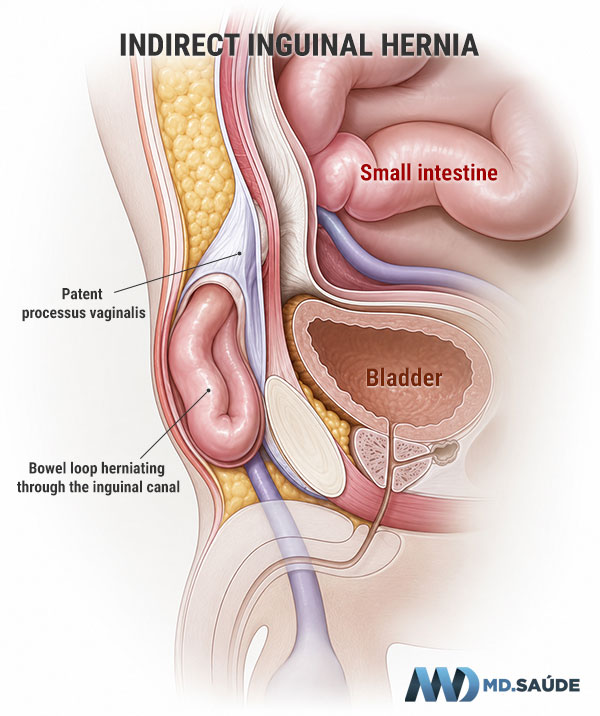
In women, the inguinal canal is also present, but its contents are different. One of the structures that passes through it is the round ligament of the uterus.
Inguinal hernias occur in approximately 1 to 5% of full-term newborns and is much more common in premature infants, in whom the frequency may reach 20–30%, particularly among those born at lower gestational ages and with lower birth weights. It is also much more common in boys, who are affected approximately 4 to 10 times more often than girls.
Although the predisposition to develop an inguinal hernia may be present from birth, the hernia does not always appear during childhood. In some people, it only becomes apparent many years later, during adulthood.
Direct inguinal hernia
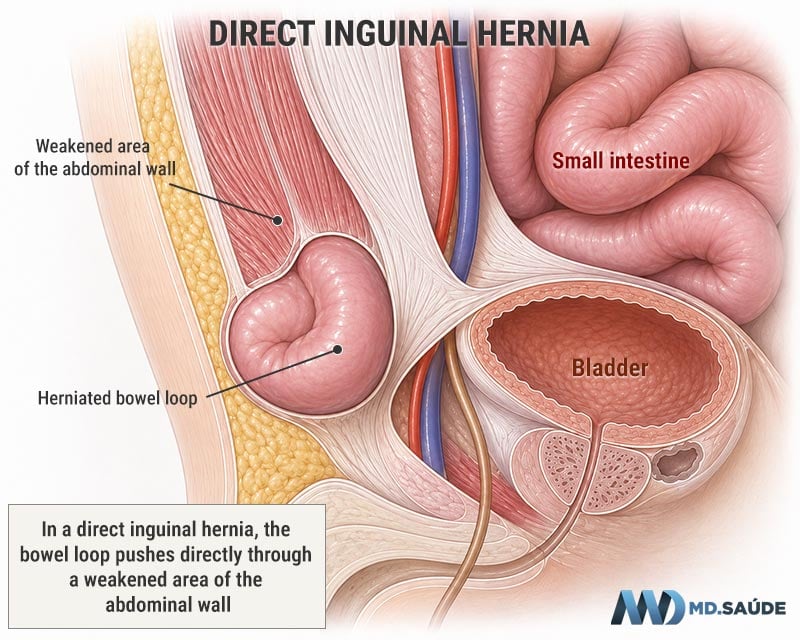
A direct inguinal hernia develops through a different mechanism. It is not caused by persistence of the connection described above but by weakening of an area of the abdominal wall near the inguinal canal. For this reason, this type is found mainly in adults and older adults, particularly men.
Direct inguinal hernias are much less common than indirect hernias, accounting for approximately one-third of inguinal hernias in men and an even smaller proportion in women.
Risk factors
Some people are more predisposed to developing an inguinal hernia. The best-established risk factors include:
- Male sex.
- Older age.
- Family history of inguinal hernia.
- Previous hernia on the opposite side.
- Prematurity, particularly in children.
- Collagen abnormalities and certain connective tissue disorders.
- Low body mass index.
- History of prostatectomy.
In addition to these factors, situations that repeatedly increase pressure inside the abdomen may contribute to the development of a hernia in predisposed individuals or make an existing hernia more apparent. Examples include chronic cough, constipation with frequent straining during bowel movements, and repeated heavy lifting.
Symptoms of an inguinal hernia
An inguinal hernia usually appears as a soft bulge or protrusion in the groin. In men, a larger hernia may extend down into the scrotum.
The bulge may be visible all the time or appear only when the patient performs an activity that increases pressure inside the abdomen, such as coughing, crying, straining during a bowel movement, or lifting something heavy. In general, the hernia becomes more noticeable when the patient is standing.
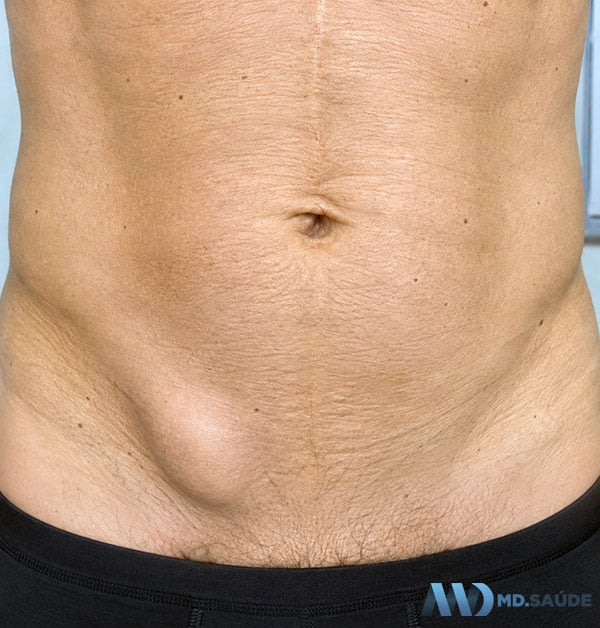
In addition to the bulge, there may be pain, a feeling of heaviness, pressure, burning, or discomfort in the groin, particularly after physical exertion or after standing for a long time.
When the patient lies down, some hernias spontaneously return to the abdomen and the bulge disappears. These are called reducible hernias.
A hernia that previously went back in and suddenly no longer does so, particularly when accompanied by significant pain, needs to be evaluated promptly. This condition is now more accurately described as an acutely irreducible hernia, although the term “incarcerated hernia” is still widely used.
Strangulation occurs when blood flow to the contents of the hernia is compromised. It is a potentially serious complication because it can cause ischemia and necrosis of the intestine or other herniated tissue.
Warning signs include:
- Irritability and persistent crying in infants.
- Severe pain or pain that is rapidly worsening.
- A hernia that no longer goes back in.
- Sudden enlargement of the hernia.
- Redness or darkening of the skin over the hernia.
- Nausea or vomiting.
- Abdominal distension.
- Inability to pass stool or gas.
- Fever.
A painful, irreducible hernia should not be forcibly pushed back in at home. Manual reduction, when appropriate, should be performed by a healthcare professional after assessing the risk of strangulation.
How is an inguinal hernia diagnosed?
In most cases, an inguinal hernia is diagnosed based solely on the medical history and physical examination.
During the examination, the doctor usually evaluates the groin while the patient is lying down and standing and may ask the patient to cough or strain. These maneuvers temporarily increase pressure inside the abdomen and make small hernias easier to identify.
When there is a typical bulge and the physical examination is convincing, imaging tests are generally not necessary to confirm the diagnosis.
An ultrasound of the inguinal region may be ordered when the physical examination is inconclusive, when the hernia is small or not visible during the appointment, or when there is groin pain without an obvious bulge.
Computed tomography (CT) and magnetic resonance imaging (MRI) are used less often and are generally reserved for situations in which the diagnosis remains uncertain, complications are suspected, or the hernia needs to be distinguished from other causes of pain or a mass in the groin.
Treatment of inguinal hernia
The only definitive treatment for an inguinal hernia is surgical repair, known as herniorrhaphy or hernioplasty. Inguinal hernia repair is one of the most commonly performed surgical procedures worldwide, accounting for more than 20 million operations each year.
There was a time when simply having an inguinal hernia was enough for doctors to recommend surgical repair in order to prevent future incarceration or strangulation. Today, however, not all inguinal hernias need to be operated on immediately after diagnosis.
Factors such as the presence and severity of symptoms, sex, age, hernia size and progression, whether the hernia can be reduced, the patient’s medical condition, and individual preferences should be considered before surgery is recommended.
Inguinal hernias that cause symptoms such as pain, a feeling of heaviness, frequent discomfort, limitation of activities, or progressive enlargement are usually repaired surgically, but generally not as an emergency. Surgery can usually be scheduled electively.
When can surgery be delayed?
In adult men with an asymptomatic inguinal hernia or one that causes only minimal symptoms, the patient may choose either surgical repair or regular medical follow-up, provided that they are properly informed about the signs of complications.
This strategy is called watchful waiting.
Watchful waiting does not make the hernia disappear. Over time, many men who are initially monitored eventually undergo surgery because the hernia begins to cause pain or discomfort. Approximately one-third undergo surgery within the first few years, and this proportion may reach around 70% after several years of follow-up.
In nonpregnant women, watchful waiting is less often recommended. This is because, among groin hernias, femoral hernias are relatively more common in women, and it is not always possible to reliably distinguish a femoral hernia from an inguinal hernia based on physical examination alone. Because femoral hernias have a higher risk of incarceration and strangulation, surgical evaluation is generally recommended even when symptoms are mild.
Treatment of irreducible and strangulated hernias
When a hernia suddenly becomes irreducible, especially if there is pain, prompt medical evaluation is required. If there are no signs that the blood supply to the herniated contents has been compromised, the doctor may attempt careful manual reduction.
If the hernia is successfully reduced, the patient may remain under observation for a few hours, and definitive surgery can be scheduled for a later time. If reduction is not possible, urgent surgical evaluation is required.
When strangulation is suspected, with compromised blood flow to the intestine or other herniated tissue, emergency surgery is required. The longer the delay, the greater the risk of ischemia, intestinal necrosis, and other serious complications.
A patient with a painful, irreducible hernia should not wait at home and should seek immediate medical attention.
Treatment in children
In children, even asymptomatic inguinal hernias are usually repaired surgically because a true inguinal hernia does not disappear spontaneously and the risk of incarceration is proportionally higher than in adults.
The optimal timing of surgery depends on the child’s age, prematurity, clinical condition, and whether previous episodes of incarceration have occurred.
In premature infants, particularly those who are still hospitalized in a neonatal unit, the timing of surgery should be individualized. In clinically stable infants, it may in some situations be safer to perform the repair after hospital discharge.
Surgical treatment
There are two main approaches to inguinal hernia repair: open surgery and laparo-endoscopic surgery.
In most adults, a synthetic mesh is used to reinforce the weakened area of the abdominal wall. Non-mesh techniques are also available and may be used in selected situations.
The choice of technique depends on the characteristics of both the hernia and the patient. Factors that are considered include whether the hernia is present on one side or both sides, whether it is a primary or recurrent hernia, the patient’s medical condition, and the experience of the surgical team. Therefore, there is no single approach that is best for every patient.
Open inguinal hernia repair
Open surgery using the Lichtenstein technique is one of the most traditional and extensively studied methods of inguinal hernia repair.
During open surgery, the surgeon makes an incision several centimeters long in the groin, identifies the hernia sac, and returns the contents of the hernia to the abdomen. The abdominal wall is then reinforced, usually with a synthetic mesh.
The mesh is generally positioned to reinforce the weakened area of the abdominal wall without interfering with the normal passage of the spermatic cord in men or the corresponding structures of the inguinal canal in women.
Open surgery may be performed under local or general anesthesia, depending on the characteristics of the patient, the hernia, and the procedure. Regional anesthesia may also be used in some situations.
Open repair remains a very safe procedure with durable results and continues to be an excellent option for many patients. It may also be particularly useful in certain clinical situations and in some emergency cases.
Laparoscopic inguinal hernia repair
Laparo-endoscopic surgery is an alternative to open surgery. The two main techniques are known as TEP and TAPP.
In the TAPP technique, the surgeon initially enters the abdominal cavity and then accesses the area of the hernia. In the TEP technique, the repair is performed without entering the abdominal cavity itself.
Both techniques use small incisions through which a camera and surgical instruments are inserted. The hernia is repaired, and a synthetic mesh is placed along the inner surface of the abdominal wall to reinforce the weakened area.
These procedures are usually performed under general anesthesia.
When performed by surgeons with adequate experience, TEP and TAPP have recurrence rates similar to those of open Lichtenstein repair.
Laparo-endoscopic surgery tends to cause less postoperative pain, carries a lower risk of chronic groin pain, and allows faster recovery, while also leaving smaller scars.
It may be particularly advantageous in patients with hernias on both sides or in those who develop a new hernia after previous open surgery.
On the other hand, laparo-endoscopic techniques require specific training and have a longer learning curve. They are also not always the best option, depending on the characteristics of the hernia, the patient’s medical condition, the available resources, and the experience of the surgical team.
Recovery after inguinal hernia surgery
Most patients are able to walk and perform light activities soon after surgery.
Pain, tenderness, bruising, and some degree of swelling around the surgical site are common during the first few days. In men, swelling may extend into the scrotum and occasionally the penis. Small hematomas or seromas may also develop and, in most cases, gradually resolve.
The time needed to return to work and usual activities varies depending on the type of surgery, the severity of pain, postoperative recovery, and the type of work performed. Many people are able to resume everyday activities within a few days, while jobs involving strenuous physical activity may require more time.
There is currently no benefit to keeping all patients at prolonged rest after uncomplicated surgery. Activities should be resumed progressively, guided mainly by the patient’s comfort and the surgeon’s specific recommendations.
Possible complications of surgery include wound infection, urinary retention, hematoma, seroma, persistent groin pain, and hernia recurrence. Serious injury to organs or blood vessels is uncommon.
Patients should contact their healthcare team if they develop fever, increasing redness or drainage from the wound, persistent vomiting, difficulty urinating, severe or worsening pain, or progressively increasing swelling in the surgical area.
- Stabilini C, van Veenendaal N, Aasvang E, et al. Update of the international HerniaSurge guidelines for groin hernia management. BJS Open.
- HerniaSurge Group. International guidelines for groin hernia management. Hernia. 2018;22(1):1–165.
- Fitzgibbons RJ Jr, Giobbie-Hurder A, Gibbs JO, et al. Watchful waiting vs repair of inguinal hernia in minimally symptomatic men: a randomized clinical trial. JAMA. 2006;295(3):285–292.
- Fitzgibbons RJ Jr, Ramanan B, Arya S, et al. Long-term results of a randomized controlled trial of a nonoperative strategy (watchful waiting) for men with minimally symptomatic inguinal hernias. Ann Surg. 2013;258(3):508–515.
- HIP Trial Investigators. Effect of Early vs Late Inguinal Hernia Repair on Serious Adverse Event Rates in Preterm Infants: A Randomized Clinical Trial. JAMA. 2024;331(12):1035–1044.
- Laparoscopic surgery for inguinal hernia repair – NICE.
- Classification, clinical features, and diagnosis of inguinal and femoral hernias in adults – UpToDate.
- Overview of treatment for inguinal and femoral hernia in adults – UpToDate.











Reader questions about this topic
Questions selected by the editor for their relevance to this article.