

Key facts about liver tests
AST and ALT are mainly markers of liver cell injury. ALT is more specific to the liver, while AST is also found in muscles and other tissues.
AST and ALT levels should be compared with the laboratory’s upper reference limit. Small elevations have a different significance from values that are five, ten, or more times above this limit.
Elevated alkaline phosphatase and GGT together are more suggestive of a hepatobiliary abnormality. Alkaline phosphatase can also increase due to bone-related causes, during growth, and during pregnancy.
GGT is sensitive but not very specific. Alcohol, medications, and various liver diseases can raise GGT levels, and an isolated high GGT result does not identify the underlying cause.
Bilirubin should be interpreted according to its direct and indirect fractions. Predominantly elevated indirect bilirubin occurs, for example, in hemolysis and Gilbert syndrome, while elevated direct bilirubin is more consistent with hepatocellular disorders or impaired bile excretion.
Normal liver tests do not rule out liver disease. Some chronic liver diseases can be present even when AST and ALT levels are normal.
What are liver function tests?
Liver function tests, often abbreviated as LFTs, are a group of blood tests that provide information about the liver and biliary system.
Despite the name, not all of these tests actually measure liver function. Some primarily detect liver cell injury, while others provide information about bile flow or the liver’s ability to produce proteins.
There is no single mandatory combination of tests. The tests ordered may vary according to the clinical situation and the laboratory.
Common liver blood tests include:
- AST (aspartate aminotransferase).
- ALT (alanine aminotransferase).
- Alkaline phosphatase (ALP).
- Gamma-glutamyl transferase (GGT).
- Total, direct, and indirect bilirubin.
- Prothrombin time (PT) and INR.
- Albumin.
- 5′-nucleotidase (5′NT).
- Lactate dehydrogenase (LDH).
Although these tests are commonly grouped under the term “liver function tests,” AST, ALT, ALP, and GGT are mainly markers of liver cell injury or hepatobiliary abnormalities rather than direct measurements of how well the liver is functioning.
Albumin and PT/INR provide information that is more closely related to the liver’s ability to synthesize proteins.
The tests selected depend on the reason for the investigation. In some situations, the goal is to detect injury to hepatocytes, the main cells of the liver. In others, the objective is to identify abnormalities of the bile ducts or determine whether liver disease has already impaired important functions of the organ.
What are AST and ALT?
AST and ALT are enzymes known as aminotransferases, sometimes also called transaminases. They are present inside cells and participate in amino acid metabolism.
The two aminotransferases most commonly measured in liver blood tests are:
- AST (aspartate aminotransferase), also called SGOT.
- ALT (alanine aminotransferase), also called SGPT.
Both are found in large amounts in hepatocytes.
When hepatocytes are injured, some of these enzymes leak into the bloodstream, causing AST and ALT levels to rise.
AST is also present in significant amounts in skeletal muscle, the heart, and other tissues. ALT can also be found outside the liver, but its concentration is much higher in hepatocytes. For this reason, ALT is considered more specific for liver injury than AST.
Before more specific cardiac biomarkers such as troponins became available, AST was sometimes used in the evaluation of myocardial infarction. It no longer plays an important role for this purpose.
The main causes of elevated AST and ALT include:
- Viral hepatitis.
- Metabolic dysfunction-associated steatotic liver disease (MASLD), previously known as nonalcoholic fatty liver disease.
- Excessive alcohol consumption.
- Liver injury caused by medications, recreational drugs, herbal remedies, or dietary supplements.
- Autoimmune hepatitis.
- Hemochromatosis.
- Wilson disease.
- Alpha-1 antitrypsin deficiency.
- Cirrhosis.
- Liver ischemia, also known as ischemic hepatitis.
- Hepatic congestion caused by heart failure.
- Liver cancer or infiltration of the liver.
- Acute bile duct obstruction.
- Muscle injury, rhabdomyolysis, or very strenuous exercise.
Because AST is also found in muscle tissue, a disproportionate increase in AST, particularly after intense exercise or in someone with muscle pain or weakness, may have a muscular rather than hepatic origin.
In these situations, measuring creatine kinase (CK) can help determine whether the abnormal result is coming from muscle.
Reference ranges for AST and ALT
Reference ranges for AST and ALT vary according to the laboratory method and may also be influenced by factors such as age and sex.
For this reason, the most appropriate reference range is the one provided with your own laboratory results.
More important than looking only at the absolute value is determining how many times the result exceeds the upper limit of normal (ULN).
For example, an ALT level of 100 U/L represents a fourfold elevation if the laboratory’s upper limit is 25 U/L, but only a twofold elevation if the upper limit is 50 U/L.
A commonly used classification is:
- Borderline elevation: less than 2 times the upper limit of normal.
- Mild elevation: 2 to 5 times the upper limit.
- Moderate elevation: 5 to 15 times the upper limit.
- Marked elevation: more than 15 times the upper limit.
- Massive elevation: extremely high levels, which may exceed 10,000 U/L.
This classification can help guide the investigation, but the degree of enzyme elevation does not directly correspond to the severity of liver disease or the amount of liver tissue that has been damaged.
A person with advanced cirrhosis, for example, may have only mildly elevated AST and ALT levels or even normal results.
When AST or ALT reaches several thousand units per liter, some causes become particularly important, including:
- Ischemic hepatitis.
- Acetaminophen (paracetamol) toxicity.
- Acute viral hepatitis.
Other conditions, including severe autoimmune hepatitis, Budd-Chiari syndrome, and acute bile duct obstruction, can also cause very marked elevations.
In addition to the degree of elevation, the AST-to-ALT ratio can provide useful clues. In many liver diseases, ALT tends to be equal to or higher than AST.
In alcohol-associated liver disease, the opposite is common: AST tends to be higher than ALT. An AST/ALT ratio greater than 2 is a classic pattern that substantially increases suspicion of alcohol-associated liver disease, although it is neither required nor sufficient for the diagnosis.
This pattern is not exclusive to alcohol. In people with advanced liver fibrosis or cirrhosis, AST can also become higher than ALT regardless of the underlying cause.
Therefore, the AST/ALT ratio should be regarded as a clue rather than a diagnostic test.
It is also important to understand that chronic liver disease can be present even when AST and ALT are normal.
This can occur, for example, in steatotic liver disease, chronic viral hepatitis, and cirrhosis. Normal aminotransferase levels, therefore, do not rule out liver disease.
LDH is another enzyme that may increase in some liver diseases, but it is found in many other tissues and is much less specific than AST and ALT. For this reason, it has a more limited role in the routine evaluation of liver disease.
What are alkaline phosphatase (ALP) and GGT?
While AST and ALT are primarily used as markers of hepatocyte injury, alkaline phosphatase and GGT are particularly useful when investigating cholestasis, which is a reduction or interruption of normal bile flow.
The liver produces bile, which travels through small channels inside the organ. These channels gradually merge to form larger ducts and eventually the major bile ducts that carry bile toward the intestine.
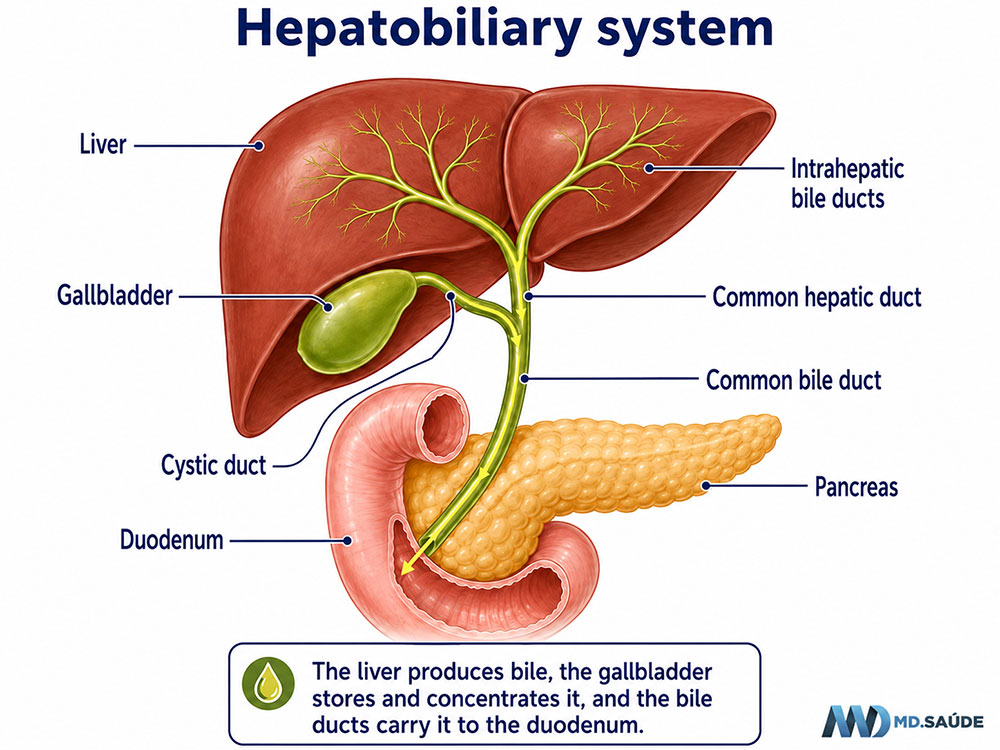
When there is a problem involving the bile ducts or bile flow, ALP and GGT levels may increase.
However, interpreting these enzymes requires some important considerations.
Alkaline phosphatase is not produced only in the liver. Large amounts are also found in bone and the placenta, as well as in several other tissues.
For this reason, an isolated elevation in ALP does not necessarily indicate liver disease.
GGT is also not specific to a single disease. It commonly increases in hepatobiliary disorders and can help determine whether an elevated ALP level is likely to come from the liver.
In simplified terms:
- High ALP + high GGT: suggests a hepatobiliary source.
- High ALP + normal GGT: suggests a non-hepatobiliary source, particularly bone, although the clinical context is still important.
- Normal ALP + high GGT: does not, by itself, indicate a cholestatic pattern. GGT is nonspecific and can rise in isolation because of excessive or chronic alcohol consumption, certain medications, and several liver diseases, including those associated with metabolic abnormalities.
An isolated GGT elevation should therefore be interpreted together with AST, ALT, bilirubin, and the clinical context.
The main hepatobiliary causes of elevated ALP and GGT include:
- Bile duct obstruction caused by gallstones, tumors, or strictures.
- Primary biliary cholangitis.
- Primary sclerosing cholangitis.
- Cholangitis associated with bile duct obstruction.
- Infiltrative liver diseases.
- Drug-induced liver injury or cholestasis.
- Some tumors of the liver or bile ducts.
- Some forms of hepatitis and cirrhosis.
Chronic excessive alcohol consumption can also raise GGT, often more markedly than ALP.
However, an elevated GGT level is not specific for alcohol consumption and should not be used by itself to establish this diagnosis.
Similarly, diseases that begin in hepatocytes can eventually interfere with bile flow and simultaneously increase AST, ALT, ALP, and GGT.
The reverse can also occur: acute bile duct obstruction may cause a substantial but temporary rise in AST and ALT.
5′-nucleotidase is another enzyme associated with the biliary tract and can help confirm that an elevated ALP level is hepatic in origin. However, it is used much less frequently than GGT.
Reference ranges for alkaline phosphatase and GGT
As with AST and ALT, there is no single reference range that applies to every laboratory.
In adults, many laboratories use an ALP reference range of approximately 30 to 120 U/L, but the exact limits vary according to the testing method. The range provided with the individual laboratory result should always take precedence.
Age is particularly important when interpreting ALP.
Children and adolescents may have significantly higher levels than adults because of active bone formation and growth. An adult reference range should therefore not be applied to a child or adolescent.
ALP can also increase physiologically during pregnancy because the placenta produces this enzyme.
Reference values for GGT vary even more between laboratories and are often different for males and females.
As an example, typical reference ranges are approximately:
- Males: 9 to 48 U/L.
- Females: 7 to 32 U/L.
These values are only examples. The laboratory-specific range should always be used when interpreting a result.
A small increase above the reference limit does not necessarily indicate significant disease. The degree of elevation and the results of the other liver blood tests must also be considered.
What is bilirubin?
Bilirubin is produced mainly during the breakdown of hemoglobin from aging red blood cells.
This process occurs largely in the reticuloendothelial system, particularly in the spleen.
Initially, unconjugated bilirubin, also commonly called indirect bilirubin, is formed. Because it is not water-soluble, it circulates in the bloodstream bound to albumin until it reaches the liver.
Inside hepatocytes, bilirubin undergoes a chemical process called conjugation, which makes it more water-soluble.
This form is called conjugated bilirubin, also commonly referred to as direct bilirubin.
Conjugated bilirubin is then excreted into bile and carried to the intestine. Its breakdown products contribute to the normal color of stool.
Blood tests can measure total bilirubin and, when needed, its direct and indirect fractions.
Determining which fraction is predominantly elevated can help identify the likely cause of the abnormality.
When red blood cell destruction increases, a process called hemolysis, more unconjugated bilirubin is produced and the indirect bilirubin level may rise.
Another common cause of elevated indirect bilirubin is Gilbert syndrome, a benign inherited condition in which the liver has a reduced ability to conjugate bilirubin.
Many people discover Gilbert syndrome incidentally when routine blood tests show a mild isolated increase in indirect bilirubin while the other liver tests remain normal.
In contrast, predominantly elevated direct bilirubin generally means that bilirubin has been conjugated by the liver, but its excretion is impaired.
This can occur both in diseases affecting hepatocytes and in conditions that interfere with bile flow, such as bile duct obstruction caused by gallstones or tumors.
In simplified terms:
- Elevated indirect bilirubin: consider increased bilirubin production, as in hemolysis, or impaired uptake or conjugation by the liver, as in Gilbert syndrome.
- Elevated direct bilirubin: consider hepatocellular disease or impaired bile excretion.
Total bilirubin is the sum of the direct and indirect fractions.
When bilirubin levels rise substantially, jaundice develops, causing yellow discoloration of the skin and, particularly, the whites of the eyes.
Jaundice usually becomes noticeable when total bilirubin reaches approximately 2 to 3 mg/dL (34 to 51 μmol/L) or higher, although the exact threshold varies from person to person.

When direct bilirubin rises significantly, it can be excreted through the kidneys, causing the urine to become dark.
In severe bile duct obstruction, much less bile pigment reaches the intestine. As a result, the stools may become very pale or clay-colored.
How to interpret patterns of abnormal liver tests
Looking at each liver test in isolation can be confusing.
In clinical practice, comparing AST, ALT, and ALP helps identify three main patterns of abnormality:
- Hepatocellular.
- Cholestatic.
- Mixed.
Hepatocellular pattern
In a hepatocellular pattern, AST and ALT are proportionally more elevated than ALP.
This pattern can occur in conditions such as:
- Viral hepatitis.
- Steatotic liver disease.
- Autoimmune hepatitis.
- Ischemic hepatitis.
- Drug-induced liver injury.
Cholestatic pattern
In a cholestatic pattern, ALP is proportionally more elevated than AST and ALT.
This pattern primarily suggests a problem involving bile flow or the biliary tract.
Mixed pattern
In a mixed pattern, both the aminotransferases and ALP are significantly elevated, with proportions that fall between the hepatocellular and cholestatic patterns.
This pattern can occur in several situations.
An important cause is liver injury caused by medications, herbal remedies, or supplements, which can produce a hepatocellular, cholestatic, or mixed pattern.
A mixed pattern can also occur in some forms of viral or autoimmune hepatitis, acute bile duct obstruction, and diseases that affect both hepatocytes and bile ducts, including some overlap syndromes involving autoimmune hepatitis and cholestatic liver diseases.
As with the other patterns, the results indicate which type of abnormality predominates but cannot determine the underlying cause by themselves.
Another possible pattern is isolated hyperbilirubinemia, in which bilirubin is elevated while AST, ALT, and ALP remain normal.
In this situation, the first step is to determine whether the increase is mainly in direct or indirect bilirubin.
When indirect bilirubin predominates, the main possibilities are increased bilirubin production, as occurs in hemolysis, or reduced bilirubin conjugation by the liver.
Gilbert syndrome is one of the most common causes of a mild isolated elevation of indirect bilirubin.
When direct bilirubin predominates while the other liver tests remain normal, the situation is less common. Possible causes include benign inherited disorders such as Dubin-Johnson syndrome and Rotor syndrome.
When direct bilirubin increases together with abnormalities in other liver tests, hepatocellular disease, cholestasis, and bile duct obstruction should be considered.
These patterns help guide the investigation, but none of them can identify a specific disease by itself.
Which tests actually assess liver function?
AST and ALT primarily indicate liver cell injury, while ALP and GGT help identify abnormalities involving the biliary tract and bile flow.
Therefore, these enzymes do not directly measure the liver’s ability to perform its functions.
Other tests provide more information about actual liver function.
Albumin and PT/INR help assess the liver’s ability to synthesize proteins, while bilirubin provides information about its ability to process and excrete substances into bile.
Albumin
Albumin is a protein produced by the liver.
When the liver’s synthetic capacity is reduced, particularly in advanced chronic liver disease, blood albumin levels may fall.
However, low albumin does not necessarily mean that liver disease is present.
Low albumin can also occur with:
- Systemic inflammation.
- Malnutrition.
- Protein loss through the kidneys.
- Intestinal diseases.
- Excess fluid in the body.
In addition, albumin remains in the circulation for a relatively long time, so its concentration does not usually reflect rapid changes in liver function.
Prothrombin time and INR
The liver also produces several proteins involved in blood clotting.
When its synthetic capacity becomes severely impaired, the prothrombin time (PT) may become prolonged and the INR may increase.
However, abnormal PT or INR values are not specific to liver disease.
They can also occur because of vitamin K deficiency, anticoagulant medications, and other disorders of blood clotting.
Therefore, there is no single blood test that can determine by itself whether the liver is functioning normally.
Proper interpretation depends on the combination of results, the pattern of abnormalities, and the person’s clinical context.
Frequently asked questions about liver function tests (FAQ)
Do high AST and ALT levels mean severe liver disease?
Not necessarily.
The degree of elevation helps guide the investigation but does not directly measure the severity of liver disease.
Mild abnormalities can occur in many conditions, while advanced chronic liver disease may be associated with only mildly elevated or even normal AST and ALT levels.
Which is more specific to the liver: AST or ALT?
ALT is more specific for liver injury.
AST is also found in significant amounts in muscles and other tissues and can therefore increase for reasons unrelated to the liver.
Can exercise increase AST and ALT?
Yes.
Intense exercise, particularly exercise that causes significant muscle injury, can raise AST and sometimes ALT.
When a muscular source is suspected, measuring CK can help clarify the cause.
Does a high GGT level mean excessive alcohol consumption?
Not necessarily.
Alcohol can raise GGT, but many other conditions can do so as well, including medications and diseases of the liver and biliary tract.
An isolated GGT result cannot determine the underlying cause.
Does a high alkaline phosphatase level mean there is a liver problem?
Not necessarily.
ALP is also produced in bone and the placenta. It can therefore be elevated in bone disorders, during normal growth in children and adolescents, and during pregnancy.
When both ALP and GGT are elevated, a hepatobiliary source becomes more likely.
Can you have fatty liver disease with normal AST and ALT?
Yes.
Normal AST and ALT levels do not rule out steatotic liver disease.
Aminotransferases are markers of hepatocellular injury, but normal levels are not sensitive enough to exclude liver fat accumulation, inflammation, or fibrosis.
Can high indirect bilirubin with otherwise normal tests be caused by Gilbert syndrome?
Yes.
Gilbert syndrome is a common cause of an isolated and usually mild increase in indirect bilirubin, particularly when AST, ALT, ALP, and the complete blood count show no abnormalities suggesting another cause.
However, the diagnosis should take the overall clinical picture into account and exclude other explanations, particularly hemolysis.
When should abnormal liver tests be investigated?
Persistent abnormalities, marked increases in liver enzymes, elevated bilirubin, or abnormal results accompanied by symptoms require medical evaluation.
The investigation also depends on factors such as:
— Current medications.
— Alcohol consumption.
— Obesity or diabetes.
— Risk factors for viral hepatitis.
— Use of supplements or herbal products.
— Previous liver disease.
Severe jaundice, confusion, unexplained drowsiness, persistent vomiting, or signs of significant acute illness associated with abnormal liver tests require prompt medical evaluation.
- Approach to the patient with abnormal liver tests – UpToDate.
- Overview of liver biochemical tests – UpToDate.
- Enzymatic measures of hepatic cholestasis (alkaline phosphatase, 5′-nucleotidase, gamma-glutamyl transpeptidase) – UpToDate.
- Evaluation of abnormal liver biochemical test results: Does the hare finally beat the tortoise? – Journal of Hepatology.
- Kwo PY, Cohen SM, Lim JK. ACG Clinical Guideline: Evaluation of Abnormal Liver Chemistries. American Journal of Gastroenterology. 2017;112(1):18–35.
- American Association for the Study of Liver Diseases (AASLD). Bilirubin Pathways and Pitfalls: From Processing to Pathology. 2025.
- American Association for the Study of Liver Diseases (AASLD). How to Approach Elevated Liver Enzymes. 2025.











Reader questions about this topic
Questions selected by the editor for their relevance to this article.