

Key Information About Creatine Monohydrate
Creatine is a supplement used primarily to improve performance during strength and high-intensity exercise and to promote muscle gain when combined with training. Among the various forms available on the market, creatine monohydrate is the most extensively studied and has the strongest scientific support.
For most healthy adults, the most commonly used dose is 3 to 5 grams per day. A loading phase is generally not necessary because continuous use at standard doses will also increase muscle creatine stores over time. The timing of supplementation has little practical importance; what matters most is taking it consistently.
At recommended doses, creatine is generally considered safe for healthy individuals, and there is no evidence that it causes kidney damage in this population. The most common side effects are gastrointestinal discomfort with high doses and a small increase in body weight caused by water retention inside the muscles rather than fat gain. People with kidney disease, relevant medical conditions, or questions about whether creatine is appropriate for them should talk to a healthcare professional before starting supplementation.
What is creatine and what does it do?
Creatine is a substance naturally produced by the body from amino acids and is also obtained in small amounts from the diet, mainly from animal-based foods. It is synthesized primarily in the liver and kidneys, circulates in the bloodstream, and is stored mostly in skeletal muscle, where its most important role is to provide a rapidly available reserve of energy for muscle contraction.
In practical terms, creatine helps muscles rapidly replenish energy during short, intense, explosive efforts such as resistance training, sprinting, jumping, and other high-power activities. For this reason, supplementation tends to be more useful for strength and short-duration exercise than for prolonged aerobic activities such as steady-state running, long-distance cycling, or swimming at a sustained pace.
When combined with appropriate training, creatine can increase the ability to perform high-intensity exercise and, over time, contribute to gains in muscle mass.
Note: Creatine should not be confused with creatinine. Creatine is involved in the muscle’s rapid energy-production system, whereas creatinine is a waste product that is eliminated mainly by the kidneys and is commonly used as a marker of kidney function in blood tests. Creatine is also not an anabolic steroid and is not considered a banned performance-enhancing substance by major sports organizations.
How to take creatine: dosage, timing, and loading phase
The most extensively studied and generally preferred form of supplementation is creatine monohydrate. In healthy adults, supplementation can be approached in two ways: with an optional loading phase followed by maintenance, or by starting directly with a maintenance dose.
In practical terms, there are two main strategies for increasing creatine stores inside the muscles:
Option 1: loading phase followed by maintenance
With a loading phase, the goal is to saturate muscle creatine stores more quickly. The classic protocol consists of taking approximately 20 g of creatine per day, divided into 3 or 4 doses—for example, 5 g four times per day—for 5 to 7 days.
Another way to describe this protocol is approximately 0.3 g/kg/day (0.3 gram of creatine per kilogram of body weight) during this short period.
After the first week, the dose is reduced to a daily maintenance dose. During the maintenance phase, the usual dose is 3 to 5 g per day.
The main disadvantage of a loading phase is the increased risk of gastrointestinal symptoms such as nausea, abdominal cramping, or diarrhea, particularly when large doses are taken at once or on an empty stomach.
Option 2: no loading phase
Without a loading phase, the person starts directly with a maintenance dose, usually 3 to 5 g of creatine per day. With this approach, muscle creatine stores increase gradually and generally reach levels similar to those achieved with a loading protocol after approximately 3 to 4 weeks of continuous supplementation.
With this approach, muscle creatine stores increase gradually and generally reach levels similar to those achieved with a loading protocol after approximately 3 to 4 weeks of continuous supplementation.
The advantage is a lower risk of gastrointestinal side effects, making this regimen more comfortable for people who do not need to achieve maximum muscle creatine saturation as quickly as possible.
Once muscle stores are saturated—either after a loading phase or after several weeks of continuous supplementation without loading—the person remains on a maintenance dose. Most studies and recommendations involving athletes use 3 to 5 g of creatine monohydrate per day to maintain elevated stores.
Higher doses
Another approach is to adjust the maintenance dose according to body weight. Some researchers use approximately 0.1 g/kg/day, which provides a practical way to scale creatine intake for people of different body sizes. Under this approach, a person weighing 70 kg (154 lb) would take about 7 g per day, while someone weighing 50 kg (110 lb) would take about 5 g per day.
For this reason, some researchers use body-weight-based doses, such as approximately 1 g of creatine for every 10 kg of body weight, or about 0.1 g/kg/day. Under this approach, a person weighing 70 kg (154 lb) would take about 7 g per day, while someone weighing 50 kg (110 lb) would take about 5 g per day.
This type of relative dosing has been studied particularly in older adults and people with greater muscle mass because it allows some adjustment for individuals at the extremes of body size.
For smaller individuals or those whose diets are naturally higher in meat, 3 to 5 g per day may be sufficient for maintenance.
In summary, for most healthy adults using creatine for physical performance, muscle gain, or other muscle-related goals, the best-established approaches are:
- With loading: Approximately 20 g/day (0.3 g/kg/day) for 5–7 days, followed by 3–5 g/day.
- Without loading: 3–5 g/day from the beginning, or approximately 1 g for every 10 kg of body weight (≈0.1 g/kg/day), taken continuously.
Do creatine supplements work?
After decades of research, there is substantial agreement that creatine supplementation can increase muscle mass in many people when combined with a regular resistance-training program.
In addition to improving exercise performance, studies suggest that creatine supplementation may improve post-exercise recovery and may help reduce the risk of certain exercise-related injuries.
During 4 to 12 weeks of training, the increase in body mass is typically about 1 to 2 kg (2.2 to 4.4 lb) greater in people taking creatine than in control groups.
The gains in muscle mass associated with creatine supplementation appear to result largely from an increased ability to perform high-intensity exercise, allowing a person to train harder, perform more work, and generate greater power.
However, not everyone responds to supplementation to the same degree, and the magnitude of the benefit can vary according to factors such as baseline creatine stores, diet, age, sex, and training status.
Among people who respond well to creatine, effects may begin to become noticeable after approximately 1 to 2 weeks when a rapid loading phase is used, compared with approximately 3 to 5 weeks when supplementation is started without loading.
There is also less evidence of meaningful performance benefits for activities that do not rely heavily on the phosphagen system, such as prolonged running, swimming, and cycling. The benefits are generally greater for repeated high-intensity efforts and short-duration activities such as sprinting and resistance exercise.
What is the best type of creatine?
Creatine monohydrate is currently the preferred form of creatine supplementation. It is the traditional form, the most extensively studied, usually the least expensive, and the form with the strongest evidence for both effectiveness and safety.
Other forms of creatine available on the market include:
- Micronized creatine: This is essentially creatine monohydrate with smaller particles, which may improve its ability to dissolve or mix in liquids. However, there is no convincing evidence that micronized creatine produces better physiological or performance results than standard creatine monohydrate.
- Creatine ethyl ester: This form was developed with the claim that it would improve absorption, but studies have not demonstrated an advantage over creatine monohydrate.
- Creatine hydrochloride (HCl): This form is more soluble, and manufacturers often claim that smaller doses are therefore sufficient. However, more research is needed to establish whether it provides any meaningful advantage over creatine monohydrate.
- Buffered creatine: This form is manufactured to have a higher pH, theoretically making creatine more stable in the stomach. Studies have not demonstrated clear benefits compared with creatine monohydrate.
- Liquid creatine: Creatine can gradually degrade into creatinine when it remains dissolved in liquid for prolonged periods. For this reason, the stability and effectiveness of premixed liquid preparations may be less reliable.
How does creatine work?
Muscles need energy to contract. Short, explosive activities that require near-maximal muscular effort, such as heavy weightlifting or a 100-meter sprint, rely heavily on an energy system known as the phosphagen system.
The immediate source of energy for muscle contraction is adenosine triphosphate (ATP). When ATP loses one of its phosphate groups and becomes adenosine diphosphate (ADP), energy is released and can be used by muscle fibers to contract.
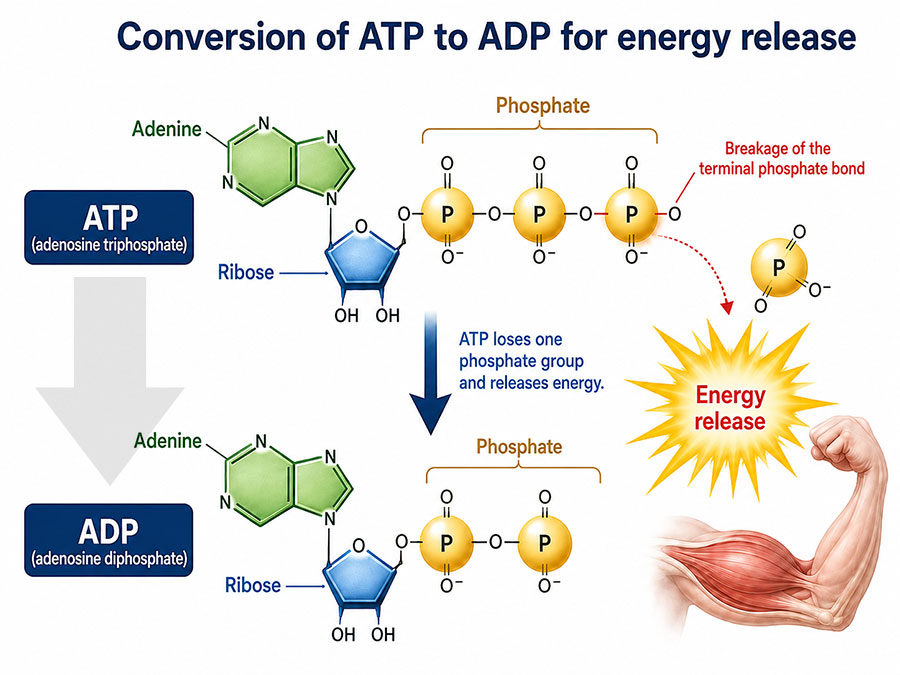
Imagine that you are at the gym. At rest, your muscles contain a small immediately available supply of ATP. You then begin lifting a heavy weight. ATP is rapidly broken down into ADP, releasing the energy needed for muscle contraction.
Because the amount of ATP stored directly inside the muscle is limited, this supply alone can sustain maximal muscular effort for only a few seconds. The muscle therefore needs a way to rapidly regenerate ATP.
This is where creatine becomes important.
Inside skeletal muscle, much of the creatine is stored as phosphocreatine. Phosphocreatine rapidly donates its phosphate group to ADP, regenerating ATP. This reaction is catalyzed by the enzyme creatine kinase.
After donating its phosphate group, phosphocreatine becomes free creatine. A small proportion of creatine and phosphocreatine is continuously converted, through a spontaneous nonenzymatic process, into creatinine, which is then eliminated mainly by the kidneys.
Because creatinine is cleared primarily through the kidneys, its concentration in the blood is commonly used as an indirect marker of kidney filtration. When kidney filtration decreases, serum creatinine generally rises.
During maximal explosive exercise, the ATP already stored in muscle lasts only a few seconds. The phosphocreatine system then helps rapidly regenerate ATP, allowing very high-power muscle activity to continue for several additional seconds.
As phosphocreatine stores decline, other energy systems become increasingly important.
The second major way to generate ATP during intense exercise is through the breakdown of muscle glycogen without requiring oxygen, a process known as anaerobic glycolysis.
This pathway cannot regenerate ATP as quickly as the phosphagen system, but it can sustain high-intensity activity for longer periods.
The third major pathway produces ATP through aerobic metabolism, using oxygen to extract energy mainly from carbohydrates and fats. This system predominates during longer-duration activities such as sustained running, cycling, and swimming.
In reality, these energy systems are never completely isolated from one another. They operate simultaneously, but their relative contribution changes depending on the intensity and duration of the activity.
During soccer, for example, all three energy systems contribute throughout the game, but their relative contribution changes from moment to moment. During very short sets of heavy resistance exercise, however, the phosphagen system plays a particularly important role.
Creatine and brain health
Creatine became widely known as a supplement for strength, muscle mass, and physical performance, but research in recent years has also investigated its possible effects on the brain, particularly regarding memory, attention, mental fatigue, and cognitive decline.
Overall, research indicates that creatine supplementation can increase creatine concentrations in the brain, although this increase tends to be smaller and slower than the increase observed in skeletal muscle.
The effect may be more relevant when the brain is under metabolic stress, such as during sleep deprivation, hypoxia, certain neurological disorders, or diets that provide very little creatine. Benefits are generally less obvious in healthy young adults whose creatine stores are already adequate.
What do studies show about cognition?
Clinical trials and systematic reviews suggest that creatine may provide some benefit in specific areas of cognition, such as short-term memory, reaction time, and processing speed, particularly in older adults, vegetarians, people experiencing sleep deprivation, or individuals with conditions that impair brain energy availability.
On the other hand, more recent studies and critical analyses have found considerable heterogeneity between trials, and many of the positive studies have important methodological limitations. Some newer meta-analyses suggest that the overall effect of creatine on cognition in healthy adults may be small.
In 2024, the European Food Safety Authority (EFSA) concluded that the available evidence was insufficient to establish a cause-and-effect relationship between creatine supplementation and improved cognitive function in the general population and therefore did not support the proposed health claim.
In summary, creatine has potential cognitive benefits, particularly when the brain is under metabolic stress or creatine availability is low, but current evidence does not support the claim that creatine clearly improves cognition in everyone under all circumstances.
What doses have been studied for brain health?
Studies investigating creatine for brain function and cognition often use higher doses than those typically used only for muscle performance:
- Classic loading protocols using approximately 20 g/day, usually 5 g four times per day, for several weeks have been shown to increase brain creatine concentrations.
- A small 8-week single-arm pilot study in people with Alzheimer’s disease used 20 g/day and found increased brain creatine together with preliminary improvements in some cognitive measures. Because the study had no placebo control and included only a small number of participants, these findings should be considered exploratory.
- Acute studies involving conditions such as sleep deprivation have used single or short-term doses of approximately 0.3–0.35 g/kg, equivalent to roughly 20–25 g for a 70 kg (154 lb) adult, with improvements in some measures of attention and information processing under fatigue.
This is where the idea of taking 10 to 20 g of creatine per day for “brain health” comes from: these doses are based on research protocols that have produced measurable increases in brain creatine and, in some cases, modest improvements in cognitive performance under metabolically stressful conditions.
At present, the evidence can be summarized as follows:
- For physical performance, muscle mass, and general health, the best-established doses remain:
- 3–5 g/day of creatine monohydrate as a fixed dose.
- Approximately 1 g for every 10 kg of body weight (≈0.1 g/kg/day) as a weight-adjusted alternative.
- For possible brain effects, including memory, attention, resistance to mental fatigue, and potential applications in neurological disease, studies have frequently used:
- A loading phase of approximately 20 g/day for several days or weeks.
- Chronic doses of approximately 10–20 g/day in experimental protocols.
From a scientific and regulatory perspective, however, there is currently no established “official dose” of creatine specifically for protecting the brain or preventing dementia.
Daily doses of 10–20 g for brain health should therefore be regarded as investigational strategies rather than routine recommendations for the general population. They are not part of established guidelines for routine use, and there is no consensus regarding the ideal long-term dose specifically for brain health.
Who might theoretically benefit the most?
Current evidence suggests that potential cognitive benefits may be more consistent in groups such as:
- Older adults and people at increased risk of cognitive decline.
- Vegetarians and vegans, who generally consume less creatine through the diet.
- People experiencing sleep deprivation, hypoxia, or other forms of cerebral metabolic stress.
- Patients with certain neurological disorders, including Alzheimer’s disease, based on preliminary studies that are not yet conclusive.
Even in these populations, results have not been consistent. Higher doses of 10–20 g/day should therefore be individualized and preferably used under medical supervision, especially in people with preexisting kidney disease or other relevant medical conditions.
Creatine in older adults
In recent years, a growing body of research has investigated creatine supplementation for several conditions related to aging.
One of the most promising potential applications is age-related sarcopenia.
Sarcopenia is a generalized decline in muscle mass, strength, and physical function that becomes more common with aging and is associated with an increased risk of falls, fractures, physical disability, and mortality.
Creatine supplementation may help improve muscle mass and aspects of physical function, including strength and resistance to fatigue, in older adults.
However, the available evidence indicates that creatine alone, without accompanying resistance training, does not usually produce substantial improvements in muscle strength or functional performance. The benefits appear to be more consistent when supplementation is combined with an appropriate resistance-training program.
Is creatine bad for you? Side effects, safety, and contraindications
In healthy adults, creatine monohydrate is generally considered safe when used at standard doses. Most safety studies have evaluated doses of approximately 3 to 5 g per day, with or without an initial loading phase, and have not found consistent evidence of kidney damage in people without preexisting kidney disease.
Creatine also does not appear to increase the risk of muscle cramps or dehydration when used appropriately.
Side effects, when they occur, are usually mild and are more common with larger doses, particularly during a loading phase. The most common include nausea, bloating, abdominal cramping, and diarrhea.
Some people also notice a relatively rapid increase in body weight during the first several days of supplementation. This usually reflects increased water content within muscle tissue rather than an increase in body fat.
Another common source of confusion is creatinine. Creatine supplementation can cause a modest increase in serum creatinine in some people, which may make a kidney function test appear abnormal even when there is no actual kidney injury.
For this reason, people taking creatine should tell their healthcare provider when kidney function tests are being interpreted, particularly if they already have reduced kidney function or are undergoing evaluation for possible kidney disease.
This does not mean that creatine should be used without caution in every situation. People with known kidney disease, an unexplained reduction in kidney function, significant comorbidities, or those taking potentially nephrotoxic medications should discuss supplementation with their healthcare provider before starting it.
Most long-term safety data involve the doses conventionally used for sports and physical performance. Higher chronic doses used for other purposes have been studied less extensively in the general population and should not be started indiscriminately.
As mentioned above, creatine at doses of 3–5 g/day has a well-established safety profile for long-term use in healthy individuals. Reviews and long-term studies have not demonstrated evidence of kidney or liver damage in healthy people taking conventional doses.
When considering chronic doses of 10–20 g/day specifically for brain health, however, the context is somewhat different. Although available research has not identified a clear major safety signal, it is important to recognize that:
- Long-term experience in people taking these doses specifically for brain health is more limited.
- Many studies include relatively small numbers of participants and have limited follow-up.
- We have less certainty regarding routine continuous use of these doses over many years in otherwise healthy people.
For most people interested primarily in general health and physical performance, conventional doses of 3–5 g/day—or a body-weight-adjusted dose when appropriate—have much more established practical use.
Daily doses of 10–20 g specifically for “brain health” should therefore be viewed as investigational rather than as routine supplementation for the general population.
Frequently asked questions about creatine (FAQ)
Does creatine cause water retention?
Creatine is osmotically active and can increase water retention, particularly during the first days of supplementation.
Studies have reported that creatine loading may cause short-term fluid retention of approximately 0.5 to 1.0 liter, which generally corresponds to the acute increase in body weight seen during the first few days of supplementation.
This increase in intracellular water does not appear to impair heat tolerance. Some studies have actually found favorable effects on hydration and thermoregulatory responses during exercise performed in hot conditions.
Is creatine an anabolic steroid?
No.
Anabolic steroids are synthetic derivatives of testosterone, an androgen hormone produced in larger amounts in men and smaller amounts in women.
Although both anabolic steroids and creatine can affect exercise performance and muscle development, their mechanisms of action, risks, and legal status are completely different.
Creatine is a legal dietary supplement and is permitted for use by athletes, while anabolic-androgenic steroids are prohibited in competitive sports unless a legitimate medical exemption applies and are prescription medications when used for approved medical indications.
Does creatine damage the kidneys?
Concerns about creatine supplementation and kidney injury are common.
However, decades of research have not shown that creatine supplementation at recommended doses damages healthy kidneys.
The situation is different for someone who already has kidney disease or unexplained impairment of kidney function. Because safety data in these populations are more limited and creatine supplementation can complicate the interpretation of serum creatinine, medical evaluation is advisable before supplementation is started.
Does creatine cause hair loss?
There is no convincing evidence that creatine supplementation causes hair loss or increases the risk of baldness.
The concern originated largely from a small 2009 study involving rugby players that reported an increase in blood concentrations of dihydrotestosterone (DHT), a testosterone metabolite, after creatine supplementation. DHT plays a role in androgenetic alopecia.
However, subsequent research has not established that creatine causes an increase in hair loss, and no clinical study has demonstrated that creatine supplementation causes baldness.
More recently, a 12-week randomized controlled trial directly evaluated hair-follicle health in men taking creatine and found no evidence that supplementation increased hair loss or adversely affected hair-growth measures.
Does creatine make you gain weight?
Creatine can cause weight gain through increased muscle mass and a small increase in water stored within muscle tissue.
It does not directly cause an increase in body fat. When supplementation is combined with appropriate training, changes in body composition may actually favor greater lean mass rather than fat mass.
Should creatine be taken before or after a workout?
There is still no clear consensus.
Clinical studies evaluating the best time to take creatine have produced mixed results, and some have suggested a possible small advantage to taking it after exercise. The evidence, however, is not strong enough to establish an important difference between pre- and post-workout supplementation.
In practice, consistency is considerably more important than timing. For most people using a conventional regimen, taking the daily dose regularly is the main priority.
- Nutritional and non-medication supplements permitted for performance enhancement – UpToDate.
- Safety of Creatine Supplementation in Active Adolescents and Youth: A Brief Review – Frontiers in Nutrition.
- Creatine Use in Sports – Sports Health, American Orthopaedic Society for Sports Medicine.
- International Society of Sports Nutrition Position Stand: Safety and Efficacy of Creatine Supplementation in Exercise, Sport, and Medicine – Journal of the International Society of Sports Nutrition.
- ISSN Exercise & Sports Nutrition Review Update: Research & Recommendations – Journal of the International Society of Sports Nutrition.
- Muscle Creatine Loading in Men – Journal of Applied Physiology.
- Common Questions and Misconceptions About Creatine Supplementation: What Does the Scientific Evidence Really Show? – Journal of the International Society of Sports Nutrition.
- Creatine and Improvement in Cognitive Function: Evaluation of a Health Claim Pursuant to Article 13(5) of Regulation (EC) No 1924/2006 – EFSA Journal.
- Creatine Monohydrate Pilot in Alzheimer’s: Feasibility, Brain Creatine, and Cognition – Alzheimer’s & Dementia: Translational Research & Clinical Interventions.











Reader questions about this topic
Questions selected by the editor for their relevance to this article.