

Key facts about white spots on nails
White spots on the nails are called leukonychia. In most cases, small white spots are caused by minor trauma to the area where the nail is formed and do not indicate disease.
Calcium deficiency is not a common cause of small white spots on the nails. One or two isolated spots are also not enough to diagnose a deficiency of vitamins, iron, or zinc.
Nail fungus can make the nail look white, but it usually causes more superficial changes that may appear rough or crumbly. The nail may also become thickened, deformed, or partially detached.
White spots that appear on several nails at the same time, form transverse bands, affect a large portion of the nail, or occur along with other nail changes should be evaluated by a doctor.
Traumatic leukonychia does not require treatment: the spot simply moves toward the tip of the finger as the nail grows and disappears when that part of the nail is trimmed.
What are white spots on nails?
White spots on the nails, medically known as leukonychia, are a very common finding that, in most cases, has no clinical significance.
In general, the spots disappear on their own as the nail grows, without requiring any treatment.
Leukonychia is usually completely harmless, causes no symptoms, and does not progress to any other type of problem. It is not a disease in itself, but simply a sign of a change in part of the nail structure, usually caused by minor trauma.
However, there are situations in which white spots on the nails may be associated with diseases, medications, poisoning, or infections of the nail itself.
Types of leukonychia and what the spots look like
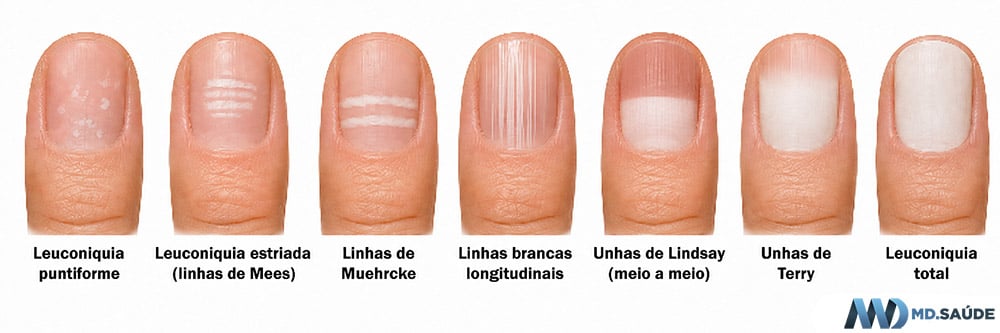
There are several types of leukonychia. The white areas may appear as small spots, lines, bands, or larger areas that make much of the nail look white.
One way to classify leukonychia is according to the part of the nail where the change occurs:
- True leukonychia: the white spot is located within the nail plate itself and does not disappear when pressure is applied to the nail. As the nail grows, the spot moves toward the tip.
- Apparent leukonychia: the change is not actually within the nail but in the nail bed underneath it. The white area may temporarily disappear when pressure is applied and does not move as the nail grows.
- Pseudoleukonychia: the white change is located on the surface of the nail rather than within the nail plate or nail bed.
Based on their appearance, some of the best-known forms include:
- Punctate leukonychia: the most common form, consisting of one or more small white spots, usually only a few millimeters in diameter.
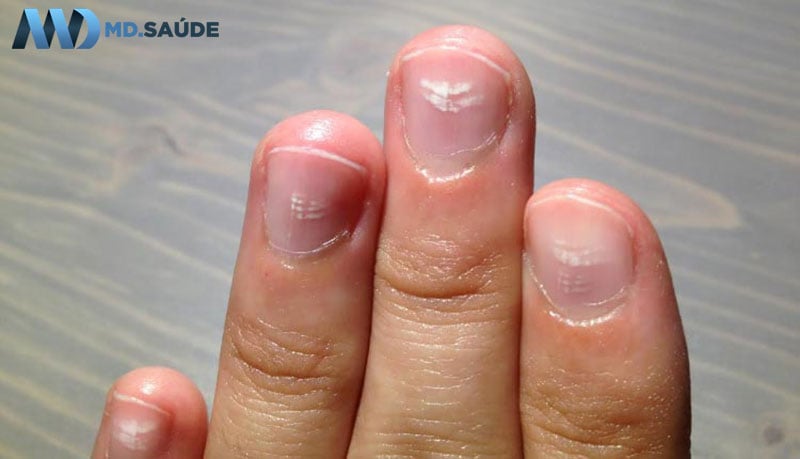
- Striate leukonychia or Mees’ lines: one or more transverse white bands running parallel to the base of the nail. Because the abnormality is within the nail plate, the lines move toward the fingertip as the nail grows.
- Muehrcke’s lines: usually appear as two transverse white bands extending across the nail. They are a form of apparent leukonychia and therefore do not move as the nail grows.
- Longitudinal white lines: white bands that run along the length of the nail.
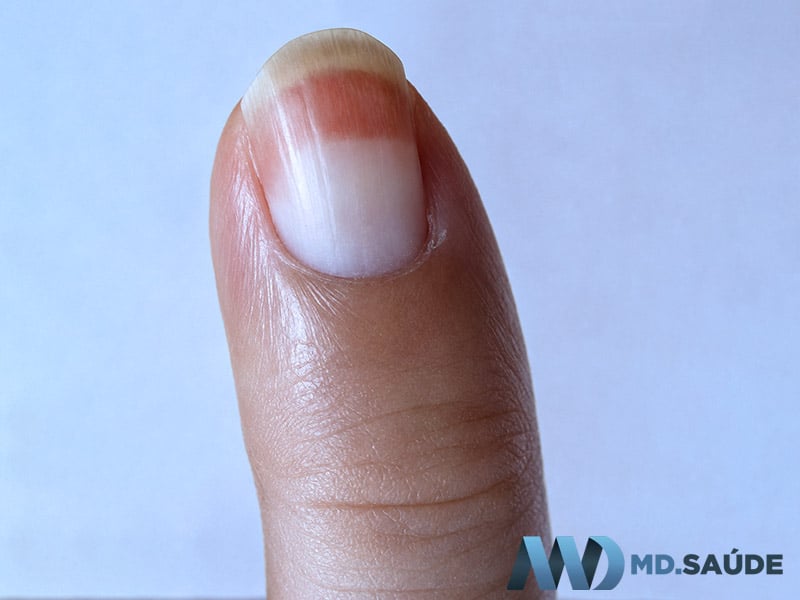
- Lindsay’s nails or half-and-half nails: the portion closest to the base of the nail is white or opaque, while the distal portion has a darker color.
- Terry’s nails: almost the entire nail appears white or opaque, with only a narrow pink or reddish band remaining at the tip.
- Total leukonychia: the entire nail is white.
Causes of white spots on nails
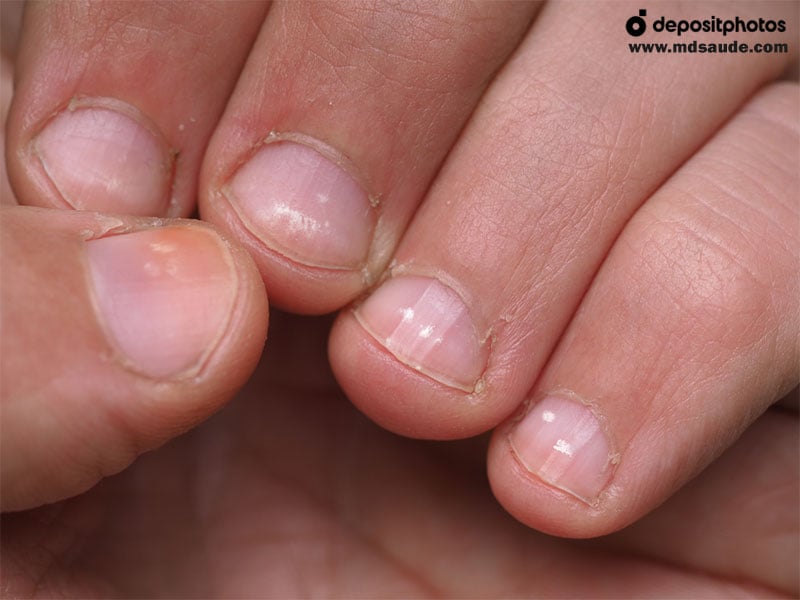
In the vast majority of cases, small white spots, known as punctate leukonychia, develop because of trauma to the nail matrix, the area where the nail is produced. Nail biting, hitting the fingers, catching a finger in a door, wearing tight shoes, or excessive pressure during a manicure are some examples.
Because there is a delay between injury to the nail matrix and the time when that part of the nail becomes visible, people often do not remember any recent trauma. This is why punctate leukonychia often seems to appear “out of nowhere.” It is the most common presentation and is almost always a benign finding.
Nail polish, nail polish remover, artificial nails, and adhesives can also cause whitish areas, which are usually more superficial and may be accompanied by dryness or peeling of the nail plate.
When similar white bands appear at the same time on several nails, especially when they extend across the entire width of the nail plate, other causes should be considered.
Mees’ lines, for example, can occur after chemotherapy, repeated trauma, and poisoning with substances such as arsenic and thallium. They have also been described in association with some infectious or systemic diseases, such as tuberculosis, although these are much less common causes.
Some medications can also cause true leukonychia. In addition to several chemotherapy drugs, cases have been reported with retinoids, cyclosporine, and sulfonamides. Sulfamethoxazole, one of the components of Bactrim, belongs to the latter class, although leukonychia is a rare adverse effect and not a common cause of white spots on the nails.
Other white nail patterns can provide clues to underlying diseases. Muehrcke’s lines are described mainly in patients with hypoalbuminemia, such as that seen in nephrotic syndrome, and can also occur during chemotherapy.
Lindsay’s nails are seen mainly in advanced chronic kidney disease.
Terry’s nails are classically associated with liver cirrhosis but may also occur in heart failure, chronic kidney disease, diabetes, and other systemic conditions. They have also been described in patients with vitiligo, leprosy (Hansen’s disease), and tuberculosis. In older adults, Terry’s nails can also occur without any specific underlying disease.
Longitudinal white lines may be seen, among other situations, in two rare inherited skin disorders: Darier disease and Hailey-Hailey disease.
True total leukonychia is rare. In the inherited form, all or nearly all nails are white from childhood. Inheritance is usually autosomal dominant, although autosomal recessive forms also exist, and mutations in the PLCD1 gene have been identified in some families.
Acquired forms of partial or total true leukonychia also occur. They are much less common and have been associated, among other situations, with selenium deficiency and medications such as hydroxyurea and trazodone.
Despite all these associations, it is important to keep the most common explanation in perspective: systemic diseases are a rare cause of isolated small white spots on the nails of otherwise healthy people. If a person has only one or two small white spots, with no other nail changes or symptoms, there is usually no reason for concern.
Do white spots on nails mean calcium or vitamin deficiency?
Usually not.
There is a widespread belief that small white spots on the nails are a sign of calcium deficiency. This is not true for typical punctate leukonychia. Studies show that these spots are not associated with reduced calcium or iron content in the nail. Trauma to the nail matrix remains the most common cause.
Zinc deficiency has been associated with leukonychia in some situations, but the isolated presence of one or two small white spots cannot be used to diagnose zinc deficiency or any other nutritional deficiency. There is also no specific vitamin deficiency that explains most cases.
Therefore, a healthy person does not need to take calcium, vitamins, or mineral supplements simply because a few white spots have appeared on the nails.
Can a white spot on the nail be nail fungus?
Yes, but it usually looks different.
One form of onychomycosis is white superficial onychomycosis, which causes whitish areas on the surface of the nail. These areas tend to look rougher, opaque, or powdery and may enlarge or merge over time. In some cases, part of the white material can be scraped from the surface of the nail.
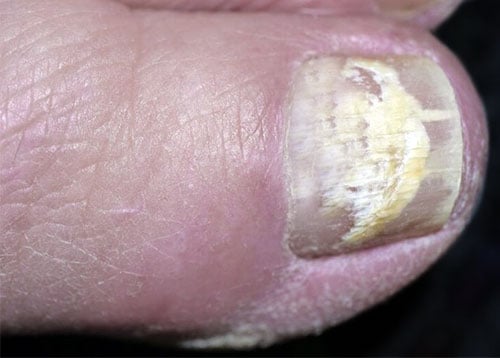
Nail fungus can also cause other changes, including thickening, deformity, brittleness, crumbling, or separation of the nail from the nail bed.
For this reason, a small, smooth white spot located within the nail that gradually moves toward the tip as the nail grows is much more suggestive of traumatic leukonychia than of nail fungus.
How to get rid of white spots on nails
Leukonychia caused by minor trauma does not require treatment. The spot naturally disappears as the nail grows and the affected portion reaches the tip, where it can be trimmed away.
There is no cream, medication, vitamin, or supplement that can make traumatic leukonychia disappear immediately. Scraping or filing the spot will not solve the problem when the change is located within the nail plate.
For fingernails, this entire process may take several months. Toenails take even longer because they grow more slowly.
When the white area is pseudoleukonychia caused by nail polish, nail polish remover, or artificial nails, reducing exposure to these products is usually enough for the nail plate to gradually return to its normal appearance.
If the cause is onychomycosis, treatment is directed against the fungus. Because not every white nail is caused by a fungal infection, antifungal treatment should not be started based solely on the appearance of the spot without first confirming the diagnosis.
When leukonychia is associated with a systemic disease, the white spot itself is not treated. The nail change is simply one manifestation of the underlying condition.
When should white spots on nails be evaluated by a doctor?
If you are healthy, the nail otherwise looks normal, and only one or two small white spots have appeared without any other changes, there is no need to seek medical attention or undergo tests to look for disease.
It is advisable to see a dermatologist when:
- White spots appear on several nails at the same time.
- They repeatedly appear without an obvious cause.
- White bands extend across the entire width of several nails.
- A large portion or the entire nail becomes white.
- The white areas progressively increase in size.
- The nail also becomes thick, rough, brittle, deformed, or begins to separate from the nail bed.
- A fungal nail infection is suspected.
- The nail changes appeared after starting a medication or there is a possibility of exposure to toxic substances.
- Other signs or symptoms are present that could suggest an underlying disease.
In these situations, the appearance of the nails and the medical history are often enough to guide the evaluation. Depending on the suspected cause, the dermatologist may order fungal testing or blood tests to investigate a possible systemic disease.
- Overview of nail disorders – UpToDate.
Leukonychia – Journal of the Turkish Academy of Dermatology.
Leukonychia striata – JAMA.
DermNet. White nail — Leukonychia: an overview.
An Idiopathic Leukonychia Totalis and Leukonychia Partialis Case Report and Review of the Literature – Skin Appendage Disorders.
Nail disorders and systemic disease: what the nails tell us – American Academy of Family Physicians.
Iorizzo M, Starace M, Pasch MC. Leukonychia: What Can White Nails Tell Us? American Journal of Clinical Dermatology. 2022;23:177-193.





Reader questions about this topic
Questions selected by the editor for their relevance to this article.