

Key facts about phimosis and paraphimosis
Phimosis occurs when the opening of the foreskin is too narrow, making it difficult or impossible to retract the foreskin over the glans. In children, however, simply being unable to fully expose the glans does not always mean there is a medical problem.
In babies and young boys, it is normal for the foreskin not to be fully retractable yet. This can persist for several years and, when there is no pain, scarring, recurrent inflammation, or significant difficulty urinating, it is usually part of normal development.
The foreskin should never be forcibly retracted, as small tears can heal with scarring and lead to pathologic phimosis.
When phimosis causes symptoms, initial treatment usually involves a topical corticosteroid combined with gentle retraction of the foreskin. Surgery is mainly reserved for cases that do not respond to treatment, recurrent balanoposthitis, and certain forms of pathologic phimosis.
Paraphimosis is a different condition: it occurs when the foreskin is retracted, becomes trapped behind the glans, and cannot return to its normal position. It is a medical emergency that must be treated promptly to prevent impaired blood flow to the glans.
What is the foreskin?
The foreskin is the retractable fold of skin that covers the tip of the penis. It acts as a protective covering for the glans, commonly known as the head of the penis.
The foreskin begins to form during the first weeks of fetal development. At birth, it is normal for the inner surface of the foreskin to still be attached to the glans and for the opening to be narrow, preventing complete retraction. This normal inability to retract the foreskin is called physiologic phimosis.
As the penis grows, these adhesions gradually separate and the foreskin opening becomes wider. Retractability progressively increases throughout childhood, but there is no single age at which all boys should be able to fully expose the glans.
Approximately half of boys can retract the foreskin beyond the glans by the end of the first year of life, and about 89% can do so by age 3. However, this means that being unable to retract the foreskin at age 3 can still be perfectly normal. Even before puberty, a foreskin that is not fully retractable may still be a physiologic variation if there are no symptoms.
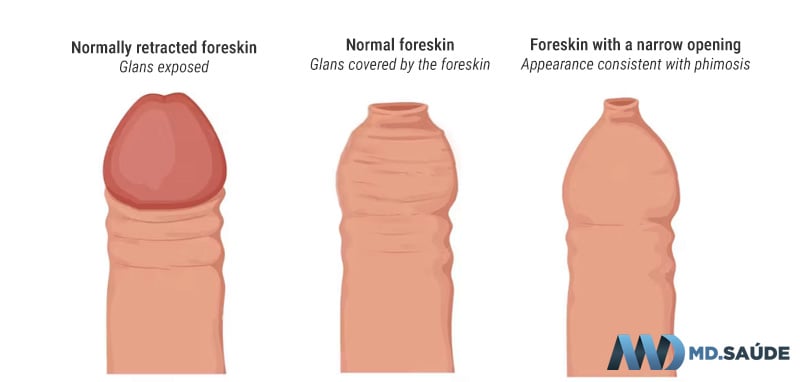
It is neither necessary nor recommended to forcibly separate the foreskin in children. Forced retraction can cause small tears, bleeding, and scarring, turning a physiologic condition into pathologic phimosis.
Once the foreskin can be easily retracted, it can be gently pulled back during bathing to clean the glans. It should always be returned to its normal position after cleaning.
What is phimosis?
Phimosis occurs when the foreskin opening is too narrow, making it difficult or impossible for the foreskin to pass over the glans.
In children, however, it is important to distinguish true phimosis from physiologic adhesions between the foreskin and the glans. Both can prevent complete exposure of the head of the penis, but they behave differently. Adhesions are extremely common during childhood and tend to resolve spontaneously as the child grows.
Phimosis can be divided into two main types: physiologic and pathologic.
Physiologic phimosis
Physiologic phimosis is related to the normal development of the foreskin.
During the first years of life, the foreskin opening may still be narrow, and the foreskin may remain partially attached to the glans. As the child grows, these adhesions usually disappear and the foreskin opening tends to become progressively wider.
There is no scarring in physiologic phimosis. When the foreskin is gently retracted, the skin remains soft and elastic.
A non-retractable foreskin, foreskin adhesions, and even some ballooning of the foreskin during urination can be part of normal development before puberty and do not require treatment in the absence of symptoms. Only about 1% of adolescents between 16 and 18 years of age still have phimosis.
Therefore, persistence of a non-retractable foreskin during childhood, by itself, does not mean that there is a disease or that surgery is necessary.
Pathologic phimosis
Pathologic phimosis occurs when the foreskin opening becomes scarred and loses its elasticity. Unlike physiologic phimosis, it may not improve spontaneously.
Some signs suggest pathologic phimosis:
- A hardened, whitish, or scarred ring at the tip of the foreskin.
- Recurrent cracks or small tears.
- Pain when attempting to retract the foreskin.
- Painful erections.
- Recurrent balanitis (inflammation of the glans) or balanoposthitis (inflammation of the glans and foreskin).
- Progressive difficulty retracting the foreskin.
- A foreskin that previously retracted normally but no longer does.
Pathologic phimosis can develop after repeated episodes of inflammation or infection of the glans and foreskin, which can cause scarring. Another cause is forcibly attempting to retract a child’s foreskin, producing small tears that subsequently heal with scar tissue and further narrow the opening.
An important cause of pathologic phimosis is genital lichen sclerosus, also known as balanitis xerotica obliterans (BXO). This is a chronic inflammatory disease that can cause whitish patches, scarring, and narrowing of the foreskin. In some patients, lichen sclerosus can also affect the glans, urethral opening, and urethra.
Phimosis in adults
Phimosis can also develop in adulthood, including in men who were previously able to retract their foreskin without difficulty.
In these cases, there is usually an underlying process that has caused inflammation and scarring of the foreskin opening. Causes include recurrent balanitis or balanoposthitis, trauma, and skin disorders, particularly lichen sclerosus.
Men who develop progressive difficulty retracting the foreskin, cracks, whitish areas, pain during erections, or recurrent inflammation should be evaluated by a urologist or dermatologist.
Symptoms of phimosis
The characteristic feature of phimosis is difficulty retracting the foreskin over the glans.
There are different degrees of retractability. In simplified terms, they can be classified as follows:
- Complete retraction of the foreskin, but with a tight ring below the glans, which increases the risk of paraphimosis.
- Only partial exposure of the glans.
- Minimal retraction, allowing only the urethral opening to be seen.
- Very little retraction, without exposure of the glans or urethral opening.
- Complete inability to retract the foreskin.
This classification only describes how far the foreskin can be retracted. By itself, it cannot determine whether the condition is physiologic or pathologic or whether treatment or surgery is indicated. The appearance of the foreskin, the presence of scarring, and the symptoms are more important when making this decision.
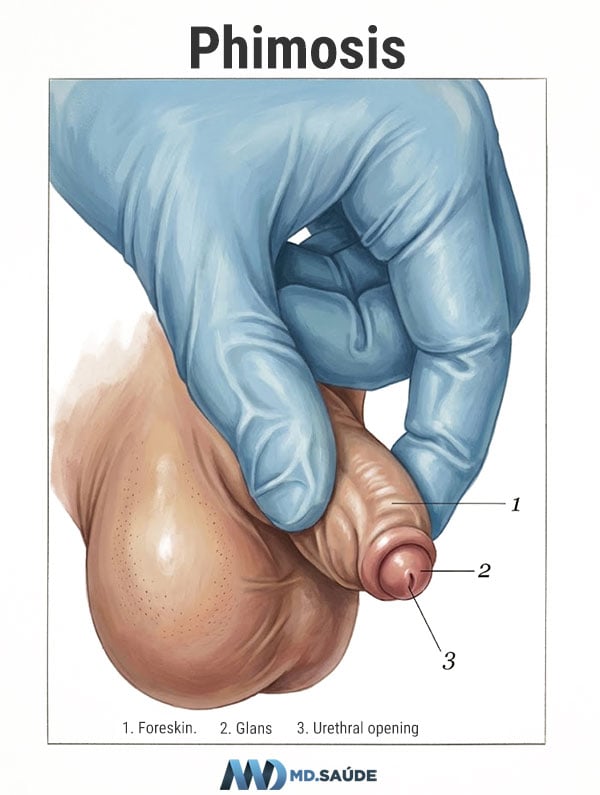
When phimosis is symptomatic, the following may occur:
- Painful erections.
- Pain or cracks when attempting to retract the foreskin.
- Recurrent episodes of balanoposthitis.
- Urinary tract infections.
- Pain or burning during urination (dysuria).
- Hematuria (blood in the urine).
- A very thin urinary stream or difficulty urinating.
- Difficulty maintaining adequate hygiene of the glans.
- Pain or discomfort during sexual intercourse.
Is ballooning of the foreskin during urination a sign of severe phimosis?
Some children experience balloon-like expansion of the foreskin during urination. Although this can be quite concerning to parents, by itself it does not mean that urine flow is obstructed or that the child needs surgery.
Ballooning can be part of the normal development of the foreskin and usually disappears as the opening becomes wider.
The condition should be evaluated when ballooning is accompanied by pain, recurrent balanoposthitis, significant difficulty urinating, a persistently very thin urinary stream, or other urinary symptoms.
What is paraphimosis?
Paraphimosis occurs when the foreskin can be retracted behind the glans but cannot return to its normal position.
The tight ring of foreskin becomes trapped in the groove behind the glans and begins to impair venous and lymphatic drainage. This causes progressive swelling, making it increasingly difficult to return the foreskin to its normal position.
Unlike phimosis, paraphimosis is a medical emergency. If the compression persists, arterial blood flow may also become impaired and, in severe cases, tissue ischemia and necrosis can occur.
The main factors that can contribute to paraphimosis include:
- A very tight foreskin.
- Forced retraction of the foreskin.
- Failure to return the foreskin over the glans after cleaning or a medical procedure.
- Balanoposthitis.
- Penile trauma.
- Piercings that interfere with the movement of the foreskin.
Paraphimosis can also occur after sexual intercourse or masturbation when the foreskin is retracted and remains trapped behind the glans.
In children, a common cause is an attempt by parents or caregivers to forcibly retract the foreskin. For this reason, whenever the foreskin is retracted, it should always be returned to its normal position covering the glans.
Symptoms of paraphimosis
Swelling of the glans and penile pain are the most common symptoms of paraphimosis.
Marked swelling of the glans and retracted foreskin, with the formation of a tight ring just behind the glans, is another highly characteristic finding.
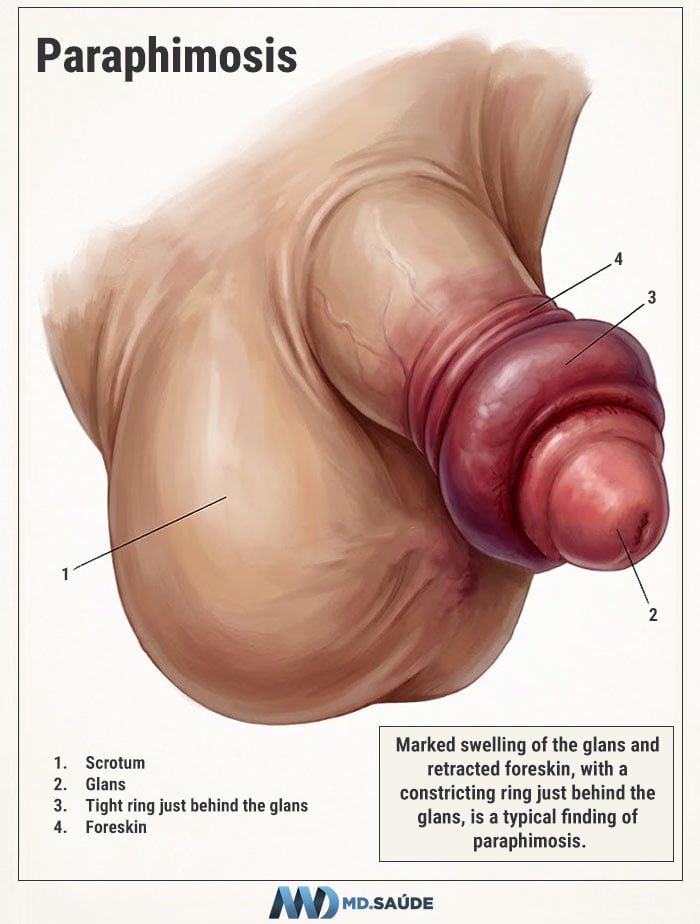
If treatment is delayed, the glans may become increasingly swollen and develop a purplish or dark discoloration due to impaired blood circulation. In severe cases, difficulty urinating may also occur.
The absence of severe pain does not rule out paraphimosis. If the foreskin is trapped behind the glans and cannot return to its normal position, medical care should be sought promptly.
Treatment of phimosis
Not all cases of phimosis require treatment.
In children without symptoms, scarring, recurrent inflammation, or significant urinary problems, a non-retractable foreskin may be part of normal development. In these cases, observation alone is usually appropriate.
The child’s age alone does not determine whether treatment is necessary. The most important factors are the presence of symptoms, scarring, recurrent inflammation, or signs of pathologic phimosis.
When phimosis is symptomatic and treatment is indicated, topical corticosteroids are usually the first option.
The medication should be applied directly to the tight ring of the foreskin, combined with gentle retraction only as far as possible without causing pain, cracks, or bleeding.
The most commonly used topical corticosteroids include betamethasone 0.05% and mometasone furoate 0.1%. Treatment usually lasts four to eight weeks, with the medication applied directly to the tight ring of the foreskin. The frequency of application depends on the corticosteroid used and the doctor’s instructions.
When applied correctly, topical corticosteroid treatment has a success rate of more than 80%. Recurrence may occur in up to approximately 17% of patients, which is why gentle and regular retraction of the foreskin during hygiene is usually recommended after improvement.
Exercises should not involve pulling the foreskin forcefully. The goal is simply to promote gentle, progressive retraction.
Physiologic adhesions between the foreskin and the glans do not respond to corticosteroids and should not be forcibly separated.
Surgery for phimosis
Surgery may be indicated when phimosis causes significant symptoms and does not respond adequately to conservative treatment or when there are recurrent episodes of balanoposthitis.
Persistent limited retractability of the foreskin, in the absence of symptoms or pathologic scarring, is not by itself an indication for surgery. Likewise, isolated ballooning of the foreskin during urination is not an indication for surgery.
The approach to childhood phimosis has changed over time. In the past, age and persistent difficulty retracting the foreskin were more commonly used as criteria for referral and treatment. It is now understood that a non-retractable foreskin may persist for several years as part of normal development. For this reason, current guidelines place greater emphasis on symptoms, scarring, and other signs of pathologic phimosis than on age alone.
The most commonly performed surgery for phimosis is circumcision, also known as posthectomy, in which the foreskin is removed.
Circumcision can be performed under local, regional, or general anesthesia, depending mainly on the patient’s age and the characteristics of the case.
During the first few days, some degree of pain, swelling, and increased sensitivity of the glans is common. Sexual intercourse and masturbation should only be resumed after adequate healing, generally after at least four weeks.
In some patients, particularly children, a preputioplasty may be performed. This procedure widens the tight foreskin opening while preserving the foreskin. Its main disadvantage is the possibility that phimosis may recur.
In boys with confirmed balanitis xerotica obliterans (BXO), circumcision is one of the main treatment options and is recommended by the European Association of Urology. In adults, however, lichen sclerosus can also initially be treated with potent topical corticosteroids under medical supervision, with surgery mainly reserved for cases with persistent narrowing or an inadequate response to treatment.
We explain the procedure in detail in the article: Circumcision: Risks, Benefits and Postoperative Care.
Treatment of paraphimosis
As mentioned above, paraphimosis is a medical emergency and requires prompt treatment.
Initial treatment usually involves carefully compressing the glans and swollen tissue to reduce the swelling and then attempting to return the foreskin over the glans. Anesthesia or pain medication is often needed to perform the maneuver.
If manual reduction is not possible, a small incision in the constricting ring or another emergency surgical procedure may be necessary.
After the acute episode has been resolved, a urologist should evaluate whether phimosis or another foreskin abnormality is present that could increase the risk of recurrence.
Frequently asked questions about phimosis and paraphimosis (FAQ)
What is the glans?
The glans is the rounded, sensitive part at the tip of the penis, commonly known as the head of the penis. It is normally covered by the foreskin.
What is the foreskin?
The foreskin is the skin that covers and protects the glans. Under normal circumstances, it becomes progressively more retractable during development, allowing the head of the penis to be exposed.
How do I know if I have phimosis?
In adolescents and adults, phimosis usually presents as a tight ring of foreskin that makes it difficult or impossible to expose the glans.
There may be pain during retraction, cracks, painful erections, recurrent inflammation, or difficulty during sexual intercourse.
In children, however, being unable to fully retract the foreskin does not necessarily mean pathologic phimosis is present. A non-retractable foreskin may be part of normal development, particularly when there is no pain, scarring, or recurrent infection.
At what age does phimosis go away naturally?
There is no exact age that applies to every boy.
Foreskin retractability increases progressively throughout childhood and may remain incomplete for several years without indicating disease. About 89% of boys can retract the foreskin by age 3, but non-retractability can still be physiologic after this age. Only about 1% of adolescents between 16 and 18 years of age have phimosis.
More important than age is whether there is scarring, pain, cracks, recurrent inflammation, or loss of a degree of retractability that was previously present.
Can someone with phimosis have sex?
Yes. Men with phimosis may be able to have sexual intercourse normally, particularly when the narrowing is mild.
In more pronounced cases, however, pain, difficulty retracting the foreskin, cracks, and bleeding may occur during intercourse. If the foreskin is retracted and becomes trapped behind the glans, paraphimosis may develop.
Can phimosis cause premature ejaculation?
There is no well-established direct relationship between phimosis and premature ejaculation.
Phimosis can cause pain, discomfort, or anxiety during sexual intercourse, but premature ejaculation is a different problem and should be evaluated separately.
Does every child with phimosis need steroid cream?
No. Physiologic phimosis and asymptomatic adhesions do not require treatment. Topical corticosteroids are mainly indicated when symptomatic phimosis is present and treatment is necessary.
- EAU Guidelines on Paediatric Urology – Phimosis and Other Abnormalities of the Penile Skin – European Association of Urology, 2026.
- Topical corticosteroids for treating phimosis in boys – Cochrane Database of Systematic Reviews, 2024.
- Clinical Practice Guidelines: The penis and foreskin – Royal Children’s Hospital Melbourne.
- Tight foreskin (phimosis)– British Association of Urological Surgeons.
- Lichen sclerosus in males – British Association of Dermatologists.
- Care of the uncircumcised penis in infants and children – UpToDate.
- Paraphimosis: Clinical manifestations, diagnosis, and treatment – UpToDate.


![Pictures: Syphilis – All stages [Warning: Strong Images]](https://www.mdsaude.com/wp-content/uploads/sifilis-imagem-225x127.jpg)




Reader questions about this topic
Questions selected by the editor for their relevance to this article.