

Summary
Key points about the ESR test
- What is the ESR? It is a blood test that measures how quickly red blood cells settle to the bottom of a tube containing blood.
- What is it used for? To help investigate inflammatory conditions and monitor the activity of certain diseases.
- What is a normal ESR? It depends on age, sex, and the laboratory method used. In younger adults, it is usually below 15–20 mm/h.
- What does a high ESR mean? It may indicate inflammation, but it can also occur with older age, anemia, pregnancy, and other conditions.
- When is an ESR result concerning? Values above 100 mm/h deserve particular attention because they are often associated with significant medical conditions, although exceptions exist.
- Do you need to fast for an ESR test? No. An ESR test on its own does not require fasting.
What is the ESR blood test?
The erythrocyte sedimentation rate, commonly known as the ESR, is a blood test used to assess whether inflammation may be present in the body, such as that caused by infections, autoimmune diseases, and certain types of cancer. The test may also be referred to as the sedimentation rate or sed rate.
ESR is a nonspecific marker of inflammation. This means that an elevated result may indicate that something is happening in the body, but the test alone cannot identify the disease responsible or where it is located.
Measuring the ESR is relatively simple. A blood sample is placed in a type of test tube, which is kept upright, and the rate at which red blood cells (erythrocytes) settle is measured over one hour.
The result is expressed in millimeters per hour (mm/h). For example, an ESR of 30 mm/h means that the red blood cells have settled a distance of 30 millimeters over one hour.
The traditional method of measurement is called the Westergren method. Today, many laboratories use automated equipment that can perform the analysis more quickly.
What does ESR at one hour mean?
When a laboratory report states “ESR, 1st hour,” it means that red blood cell sedimentation was measured over the first 60 minutes. This is the result normally used in clinical interpretation.
In the past, some laboratories also measured ESR after two hours, on the assumption that this second reading might provide additional information about the intensity of inflammation. However, subsequent studies have not demonstrated a meaningful clinical benefit from this practice. Today, the first-hour result is considered sufficient and is the international standard for interpreting the test.
How does the ESR test work?
When an inflammatory process is taking place, whether due to an infection, active autoimmune disease, acute pancreatitis, or advanced cancer, the liver may increase its production of several proteins known as acute-phase proteins.
One of the most important is fibrinogen, a protein involved in blood clotting whose concentration also increases during inflammatory processes.
Fibrinogen acts somewhat like glue, helping red blood cells (erythrocytes) come together and aggregate. Instead of remaining separate, the cells begin to cluster, forming structures that resemble stacks of coins, known as rouleaux.
These clusters settle faster than individual red blood cells. Therefore, the more of these aggregates that form, the higher the erythrocyte sedimentation rate tends to be.
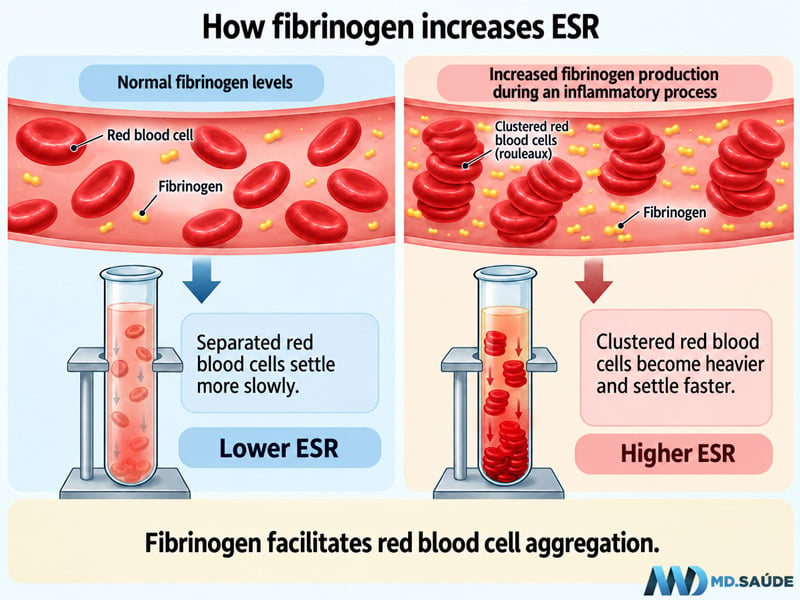
The ESR is therefore an indirect indicator of increased fibrinogen and other proteins that promote red blood cell sedimentation, which may be a sign of an ongoing inflammatory process.
It is important to note, however, that fibrinogen is not the only substance that affects the result. Other blood proteins, particularly immunoglobulins (antibodies), can also increase sedimentation. In addition, changes in the number, size, or shape of red blood cells can affect ESR even when no inflammation is present.
These factors explain why ESR does not always accurately reflect the intensity of an inflammatory process.
What is the ESR test used for?
ESR is mainly used to help investigate inflammatory diseases and monitor the course of certain medical conditions.
Some situations in which a doctor may order an ESR test include:
- Investigating a persistent fever with no identified cause.
- Assessing patients with joint or muscle pain that may be related to an inflammatory disease.
- Investigating autoimmune diseases and vasculitis.
- Monitoring disease activity in rheumatic conditions such as rheumatoid arthritis and polymyalgia rheumatica.
- Monitoring certain chronic infections, such as osteomyelitis (bone infection).
One of the main uses of ESR is monitoring diseases that have already been diagnosed. If a patient has an inflammatory disease and their ESR was elevated, a gradual decrease during treatment is usually a favorable sign.
Conversely, a new increase may raise suspicion that inflammatory activity has returned, although symptoms and other test results must also be assessed.
ESR is not a good test to order indiscriminately as part of a routine health checkup. Because so many conditions can affect the result, an elevated ESR in someone without symptoms often raises more questions than it answers.
What are normal ESR values?
Normal ESR values vary according to age, sex, and the testing method used by the laboratory.
In general, women have slightly higher ESR values than men, and ESR tends to increase naturally with age.
Traditional reference values using the Westergren method are:
- Men under 50: up to 15 mm/h.
- Women under 50: up to 20 mm/h.
- Men over 50: up to 20 mm/h.
- Women over 50: up to 30 mm/h.
These values are only general references. Some laboratories use different ranges, particularly for older adults. Results should be interpreted according to the reference limits provided on the laboratory report.
Why does ESR increase with age?
Aging causes changes in blood composition and in the concentrations of certain plasma proteins, making red blood cells settle slightly faster.
For this reason, an ESR of 25 mm/h may be higher than expected in a 25-year-old man but not necessarily represent an important abnormality in a 75-year-old woman.
There is even a traditional formula for estimating the upper limit of ESR according to age:
- Men: age divided by 2.
- Women: age plus 10, divided by 2.
According to this formula, a 70-year-old man might have an ESR of approximately 35 mm/h, while a woman of the same age might have a value of up to 40 mm/h.
These formulas are estimates, not universal limits of normality. They help explain why small increases in older adults do not always indicate disease, but they do not replace clinical assessment or the laboratory’s reference ranges.
Normal ESR values in children and during pregnancy
ESR is usually low in children. In newborns, values are generally between 0 and 2 mm/h. After the neonatal period, the limits vary according to age and the method used, so it is important to consult the laboratory’s pediatric reference ranges.
During pregnancy, ESR commonly increases progressively, especially in the second half of pregnancy. This occurs because of changes in blood proteins and a relative reduction in red blood cell concentration as plasma volume increases.
Therefore, an ESR considered elevated in a nonpregnant woman may be normal during an uncomplicated pregnancy.
What does a high ESR mean?
A high ESR means that red blood cells are settling faster than expected.
Most often, this occurs because of increased levels of blood proteins that promote red blood cell aggregation, such as fibrinogen and certain immunoglobulins.
The main causes of a high ESR are infectious, inflammatory, and autoimmune diseases. Some types of cancer can also cause substantial increases.
However, having a high ESR does not necessarily mean you have a serious disease. The test result can also be affected by factors such as age, anemia, pregnancy, obesity, or chronic kidney disease.
A high ESR does not itself cause symptoms. When a patient has fever, fatigue, joint pain, weight loss, or other symptoms, these are caused by the underlying condition responsible for the abnormal result, not by the increase in erythrocyte sedimentation rate.
Main diseases that cause a high ESR
Many diseases can increase ESR. Some examples include:
- Infections: tuberculosis, pneumonia, osteomyelitis, infective endocarditis, and other acute or chronic infections.
- Autoimmune diseases: lupus, rheumatoid arthritis, and vasculitis.
- Inflammatory diseases: polymyalgia rheumatica, acute pancreatitis, inflammatory bowel diseases (Crohn’s disease or ulcerative colitis), and gout attacks.
- Cancers: certain types of cancer, especially lymphomas and multiple myeloma.
- Tissue injuries: trauma, surgery, and conditions that cause tissue damage or inflammation.
This list contains only a few examples. ESR cannot diagnose any of these diseases. It merely suggests the possibility of inflammation or another change that can make red blood cells settle faster.
Is an ESR between 30 and 60 mm/h concerning?
There is no universal classification that can determine how severe a disease is based solely on the ESR value.
An ESR of 30 mm/h, for example, may represent a mild increase in a younger adult or fall within the expected range for an older person.
Values of 40, 50, or 60 mm/h represent more pronounced elevations in many adults and may occur with infections, rheumatic diseases, and other inflammatory conditions. However, noninflammatory factors may also influence these values.
Two examples help illustrate this limitation:
Example 1: A 75-year-old woman with anemia but no symptoms has an ESR of 45 mm/h. This result, on its own, is not enough to suspect a serious infection, an autoimmune disease, or cancer.
Example 2: A 35-year-old man with persistent fever, weight loss, and an ESR of 45 mm/h has a condition that warrants further investigation, not because the number is particularly high, but because it is accompanied by symptoms.
Therefore, the importance of an ESR result depends not only on the number, but also on the clinical context in which it occurs.
What if the ESR is above 100 mm/h?
In this situation, things are somewhat different. A very high ESR, above 100 mm/h, often provides useful diagnostic information because values of this magnitude are frequently associated with clinically significant diseases, such as certain cancers, active autoimmune diseases, or serious infections, including osteomyelitis, endocarditis, and tuberculosis.
An ESR above 100 mm/h warrants careful medical evaluation, especially when it appears for the first time and there is no known explanation.
There are, however, exceptions. Patients with advanced kidney failure, particularly those receiving dialysis, can have a very high ESR, including values above 100 mm/h, even without signs of an acute infection or another significant inflammatory disease. In these patients, factors such as anemia and changes in blood proteins may contribute to the increase.
Therefore, although an ESR above 100 mm/h deserves attention, it does not, by itself, prove that a patient has a serious infection or cancer.
Other factors that can increase ESR
Besides infectious and inflammatory diseases, other factors can increase ESR, including changes in red blood cell numbers, blood proteins, and certain physiological conditions.
The main ones include:
- Anemia: When the number of red blood cells is reduced, they encounter less resistance as they settle. As a result, people with anemia may have a high ESR even without an associated inflammatory disease.
- Older age: As explained earlier, ESR tends to increase naturally with age.
- Pregnancy: Changes in blood volume and plasma proteins can substantially increase ESR during pregnancy.
- Chronic kidney disease: People with advanced kidney failure, nephrotic syndrome, or significant abnormalities in blood proteins may have persistently elevated ESR values, even in the absence of an acute inflammatory process.
- Obesity: Excess body fat can cause low-grade chronic inflammation, leading to mild increases in ESR.
- Changes in immunoglobulins: Some diseases cause increased antibody levels or the production of monoclonal proteins, which can accelerate red blood cell sedimentation. This can occur in multiple myeloma.
In addition to these conditions, technical problems during blood collection, sample storage, or processing can also alter the result.
What does a low or normal ESR mean?
In most cases, a low ESR has no clinical significance, particularly when a person has no symptoms or other abnormal laboratory findings. Values of 1, 2, or 3 mm/h, for example, are perfectly normal in many healthy people.
However, a low ESR or a result within the reference range does not necessarily mean that inflammation is absent.
Certain conditions can slow red blood cell sedimentation, keeping ESR low even when an inflammatory disease is present. These include:
- Polycythemia: A marked increase in the number of red blood cells, making it harder for them to settle.
- Sickle cell disease and other red blood cell abnormalities: Changes in the shape or size of red blood cells, such as microcytosis, can interfere with their aggregation.
- Hypofibrinogenemia: A reduced concentration of fibrinogen in the blood.
Medications that reduce inflammatory activity, such as corticosteroids and certain immunosuppressants, can also lower ESR.
In addition, ESR generally increases more slowly than other inflammatory markers. During the first few hours of an acute infection, for example, ESR may still be normal. Some conditions, such as rheumatoid arthritis and lupus, may also be active without necessarily causing ESR to rise.
Another important example is giant cell arteritis, also known as temporal arteritis. Although ESR is often markedly elevated in this disease, some patients have normal values.
This is particularly important because temporal arteritis can cause irreversible vision loss. People over 50 who develop a new, persistent headache, especially if accompanied by pain when chewing or changes in vision, need urgent medical assessment even if their ESR is normal.
Therefore, a low ESR is usually not a cause for concern, but a normal ESR does not rule out an inflammatory disease.
What is the difference between ESR and CRP?
C-reactive protein (CRP) is another example of an acute-phase protein whose production by the liver increases during inflammatory processes.
The main difference is that ESR measures the inflammatory response indirectly, while the CRP test directly measures the concentration of a protein produced by the liver.
CRP usually rises more quickly after inflammation begins and also tends to return to normal sooner as the underlying problem improves. ESR responds more slowly and may remain elevated for longer.
For this reason, it is possible to have a high ESR with normal CRP or elevated CRP with normal ESR. These differences may reflect the stage of an illness, the type of inflammation, or factors that specifically affect red blood cell sedimentation.
Lupus is one example: ESR may be elevated during periods of disease activity while CRP remains normal or rises only slightly.
To better understand these differences and how to interpret CRP results, read: C-Reactive Protein (CRP): Normal Levels and What High Results Mean.
How is the ESR test performed? Is fasting required?
The ESR test is performed using a routine blood sample, usually taken from a vein in the arm.
The procedure is quick and similar to the one used for a complete blood count (CBC) and other laboratory tests.
Fasting is not required for an ESR test. Patients can eat and drink water as usual before their blood is collected.
However, if other blood tests are ordered at the same time, those tests may require specific preparation.
There is also no need to stop taking medications on your own. What matters is telling your doctor which medications you use, as some can affect the inflammatory response and, consequently, the ESR result.
It is important to know that ESR testing is sensitive to the conditions in which a sample is stored and processed. Excessive delays before analysis, inappropriate temperature, or incorrect positioning of the tube can change the result.
In addition, different laboratory methods do not always produce identical results. Therefore, when the aim is to follow a disease over time, it may be useful to have repeat measurements performed at the same laboratory, especially if there are substantial differences between the methods used.
What should you do if your ESR is abnormal?
The first thing to understand is that there is no treatment for a high or low ESR itself. ESR is simply a laboratory marker, not a disease.
When the result is abnormal, the doctor needs to consider the patient’s age, symptoms, medical history, medications, and other laboratory results.
A mild, isolated increase in someone without symptoms may not require an extensive diagnostic investigation. Depending on the circumstances, clinical follow-up or repeating the test later may be sufficient. On the other hand, an ESR that remains elevated or increases progressively over several measurements deserves more attention, especially when there is no known explanation.
A substantial elevation, particularly when accompanied by fever, unexplained weight loss, joint pain, a recent-onset headache, or other symptoms, warrants a more detailed assessment.
A complete blood count, C-reactive protein, kidney function tests, and other investigations may help identify the cause, but which tests are ordered should depend on the suspected diagnosis.
It is also important to remember that the erythrocyte sedimentation rate is not a test for detecting cancer. Although some cancers can cause a marked increase in ESR, an abnormal result does not, by itself, mean that a tumor is present. Likewise, a normal ESR does not rule out cancer or any other disease.
The main value of ESR testing is to provide additional information that, when interpreted alongside the clinical picture, can help doctors guide the diagnostic investigation or monitor the response to treatment.
- Antonelli M. Acute phase reactants. UpToDate.
- Kratz A, et al. ICSH recommendations for modified and alternate methods measuring the erythrocyte sedimentation rate. International Journal of Laboratory Hematology. 2017;39:448–457.
- Alende-Castro V, et al. Factors influencing erythrocyte sedimentation rate in adults: New evidence for an old test. Medicine (Baltimore). 2019;98.
- National Library of Medicine. Erythrocyte Sedimentation Rate (ESR). MedlinePlus.
- Miller A, Green M, Robinson D. Simple rule for calculating normal erythrocyte sedimentation rate. British Medical Journal. 1983;286:266.
- Fincher RM, Page MI. Clinical significance of extreme elevation of the erythrocyte sedimentation rate. Archives of Internal Medicine. 1986;146:1581–1583.





Reader questions about this topic
Questions selected by the editor for their relevance to this article.